 Connexion
Show HN: Extracting React apps from Figma Make's undocumented binary format
23 janvier 2026 à 05:07


 Jonathan Capehart has built a career on attention. As a journalist, he has spent decades interrogating power and translating the churn of American politics into something legible for audiences. But in a recent conversation with The Advocate, Capehart’s focus shifted away from institutions and toward something more elemental: how people learn who they are, how they decide what they will accept, and how they build a sense of home when traditional structures fall short.
While it has become a word, laser used to be an acronym: “light amplification by stimulated emission of radiation”. But there is an even older technology called a maser, which is the same acronym but with light switched out for microwaves. If you’ve never heard of masers, you might be tempted to dismiss them as early proto-lasers that are obsolete. But you’d be wrong! Masers keep showing up in places you’d never expect: radio telescopes, atomic clocks, deep-space tracking, and even some bleeding-edge quantum experiments. And depending on how a few materials and microwave engineering problems shake out, masers might be headed for a second golden age.
Simplistically, the maser is — in one sense — a “lower frequency laser.” Just like a laser, stimulated emission is what makes it work. You prepare a bunch of atoms or molecules in an excited energy state (a population inversion), and then a passing photon of the right frequency triggers them to drop to a lower state while emitting a second photon that matches the first with the same frequency, phase, and direction. Do that in a resonant cavity and you’ve got gain, coherence, and a remarkably clean signal.
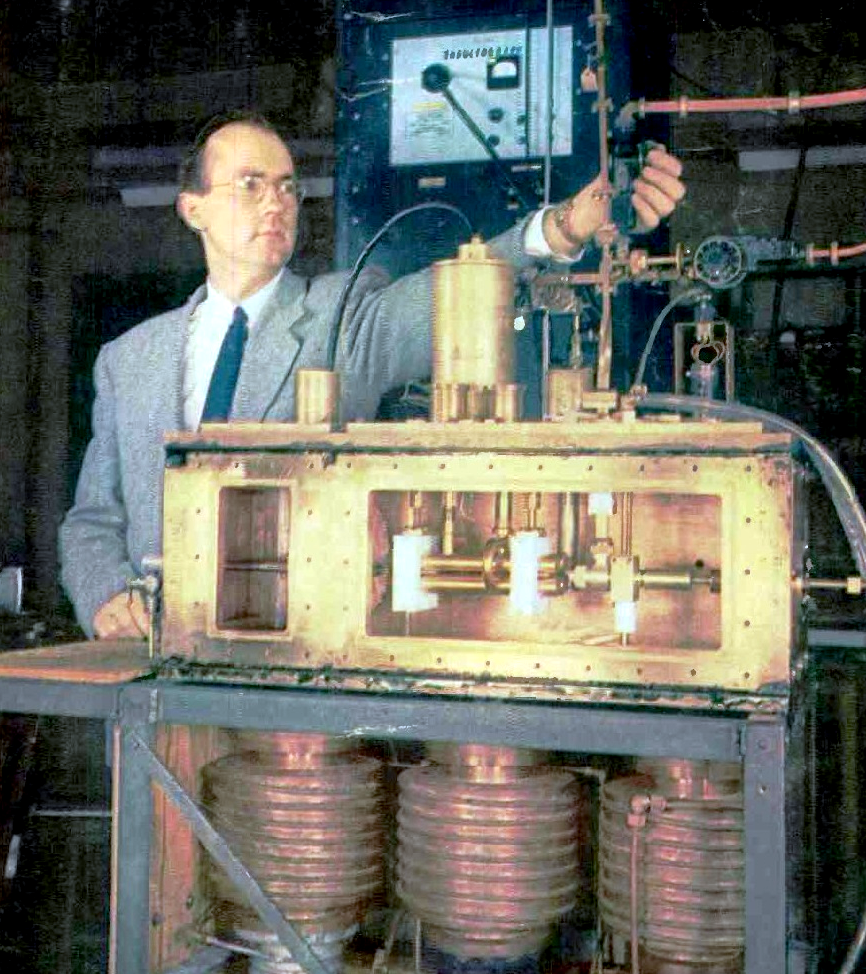
However, there are many engineering challenges to building a maser. For one thing, cavities are bigger than required for lasers. Sources of noise and the mitigations are different, too.
The maser grew out of radar research in the early 1950s. Charles Townes and others at Columbia University used ammonia in a cavity to produce a 24 GHz maser, completing it in 1953. For his work, he would share the 1964 Nobel Prize for physics with two Soviet physicists, Nikolay Basov and Alexander Prokhorov, who had also built a maser.
By 1960, the laser appeared, and the maser was nearly forgotten. After all, a visible-light laser is something anyone can immediately appreciate, and it has many spectacular applications.
At the time, the naming of maser vs laser was somewhat controversial. Townes wanted to recast the “M” in maser to mean “molecular,” and pushed to call lasers “optical masers.” But competitors wanted unique names for each type of emission, so lasers for light, grasers for gamma rays, xasers for X-rays, and so on. In the end, only maser and laser stuck.
Masers have uses beyond fancy physics experiments. Trying to detect signals that are just above the noise floor? Try a cryogenic maser amplifier. That’s one way the NASA Deep Space Network pulls in signals. (PDF) You cool a ruby, or other material, to just a bit of 4 °K and use the output of the resulting maser to pull out signals without adding much noise. This works well for radio astronomy, too.
Need an accurate time base? Over the long term, a cesium clock is the way to go. But over a short period, a hydrogen maser clock will offer less noise and drift. This is also important to radio astronomy for building systems to use very long baseline interferometry. The NASA network also uses masers as a frequency standard.
While we didn’t have our own masers until 1953, nature forms them in space. Water, hydroxyl, and silicon monoxide molecules in space can form natural masers. Scientists can use these astrophysical masers to map regions of space and measure velocities using Doppler shifts.
Harold Weaver found these in 1965 and, as you might expect, they operate without cavities, but still emit microwaves and are an important source of data for scientists studying space.
While traditional masers are difficult to build, modern material science may be setting the stage for a maser comeback. For example, using nitrogen-vacancy centers in diamonds rather than rubies can lead to masers that don’t require cryogenic cooling. A room-temperature maser could open up applications in much the same way that laser diodes made things possible that would not have been practical with high-voltage tubes and special gases.
Masers can produce signals that may be useful in quantum computing, too. So while you might think of the maser as a historical oddity, it is still around and still has an important job to do.
In a world where lasers are so cheap that they are a dollar-store cat toy, we’d love to see a cheap “maser on a chip” that works at room temperature might even put the maser in reach of us hackers. We hope we get there.
Andrew Spieldenner's favorite superhero growing up wasn't Superman, Batman, or Wonder Woman — it was Color Kid.A federal appeals court refused to overturn a lower court judge’s decision not to sign warrants for the arrest of out journalist Don Lemon and four others this past Friday.
Lemon reported on a protest in a Minneapolis church, and the administration is trying to arrest him because, they argue, he was not actually acting as a member of the press but was actually participating in the protest.
Related
Cops allegedly planted drugs on him & humiliatingly arrested him. Now he’s running for Senate.
Last week, a federal magistrate judge rejected the Department of Justice’s (DOJ) attempt to criminally charge Lemon for broadcasting a protest at Cities Church in Minneapolis. The protestors called for the resignation of a pastor at the church, David Easterwood, who is also the acting field office director for Enforcement and Removal Operations (ERO) at an Immigration and Customs Enforcement (ICE) field office in St. Paul, Minnesota.
Three protestors were arrested for participating in the January 18 demonstration, and the administration has argued that the protest was an attack on a “house of worship” and, specifically, “Christian worshippers.”
Never Miss a Beat
Subscribe to our newsletter to stay ahead of the latest LGBTQ+ political news and insights.
Subscribe to our Newsletter today
The DOJ appealed the federal magistrate judge’s decision.
Two judges on a three-judge panel on the U.S. Court of Appeals for the Eighth Circuit refused to overturn the magistrate’s decision. Two of the judges were appointed by the current president and the third was appointed by Barack Obama. One of the conservative judges wrote in a brief concurring statement that the DOJ did have probable cause to arrest Lemon, but agreed with refusing their appeal on technical grounds.
They unanimously rejected the DOJ’s appeal on Friday, with the decision published on Saturday, according to the New York Post. On Monday, the DOJ announced it would no longer pursue Lemon’s arrest.
Just after the magistrate judge refused to sign off on the arrests of Lemon and the four others, the DOJ turned to Minnesota Chief U.S. District Judge Patrick Schiltz to overturn the magistrate’s decision. This enfuriated Schiltz, who wrote an angry letter to Eighth Circuit Chief Judge Steven Colloton that never in “over 40 years” had any judge he worked with ever heard of prosecutors going to a district judge to overturn a magistrate judge’s decision, because usually prosecutors will just build their case better and go back to the magistrate judge again.
Schiltz also mocked the prosecutors’ case in the letter.
“Apparently, the government believes that the arrests of the leaders of the Cities Church invasion — whose arrests have received widespread international attention — will not deter copycats, but arresting five additional suspects will,” Schiltz wrote.
“The five people whom the government seeks to arrest are accused of entering a church, and the worst behavior alleged about any of them is yelling horrible things at the members of the church. None committed any acts of violence. The leaders of the group have been arrested, and their arrests have received widespread publicity. There is absolutely no emergency… The government can still take its case to a grand jury anytime it wishes.”
Lemon has been outspoken about the attacks on the free press coming from the current administration.
In a statement last week, Lemon’s attorney, Abbe Lowell, said, “The magistrate’s reported actions confirm the nature of Don’s First Amendment-protected work this weekend in Minnesota as a reporter. It was no different than what he has done for more than 30 years, reporting and covering newsworthy events on the ground and engaging in constitutionally protected activity as a journalist.”
Lowell promised to fight the charges “vigorously and thoroughly.”
Subscribe to the LGBTQ Nation newsletter and be the first to know about the latest headlines shaping LGBTQ+ communities worldwide.
Heated Rivalry star François Arnaud has accused the National Hockey League (NHL) of using the show to sell tickets without addressing homophobia within the sport.
The 40-year-old bisexual Canadian, who plays New York Admirals captain Scott Hunter in the internationally-acclaimed romantic drama Heated Rivalry, said he hopes the North American ice hockey league does more to support its closeted LGBTQ+ players.
Earlier this month, the NHL joined the global mania around Heated Rivalry after its commissioner, Gary Bettman, said he binged the show in a single night.
READ MORE: Heated Rivalry’s François Arnaud breaks silence on love life with defiant message
A spokesperson for the league later told Rolling Stone that the show’s popularity was clearly driving interest in the sport, adding that “what those new fans will find is a warm welcome.”
Unfortunately, what new fans might also find is the continued prevalence of homophobia within the sport. A survey of US adults shared in 2023 suggests that ice hockey is considered the most anti-LGBTQ+ sport among the ‘Big Four’ – American Football, Hockey, Basketball, and Baseball.
Speaking on The Kelly Clarkson Show, Arnaud confronted the disconnect between the NHL’s love of Heated Rivalry, and the homophobia still ripe within the league.
“I just hope that the league, that’s now using the show for tweets and Instagram posts and selling tickets, will actually, like, follow through and support open identities for the players.”
At the time of reporting, there are currently no out LGBTQ+ male players in the NHL. It is the only major North American male sports league to have never had an out, active player.
Arnaud previously urged the league to address its lack of diversity, according to the Express Tribune, saying that its LGBTQ+ allyship “has to be real”.
“You can’t just put a logo up and think the work is done,” he said. “It’s about creating an environment where people actually feel safe being themselves.”
In December, UHL goaltender Brock McGillis, who became the first male hockey player to come out as gay, told PinkNews he believed Heated Rivalry wouldn’t help closeted players come out.
Responding to comments from former hockey pro Sean Avery, who claimed the show might motivate players to come out, McGillis said he “wholeheartedly” disagreed.
“It might help the people around [players] understand a little more if they’re dating somebody; hopefully,” he said. “Nobody’s like, ‘Oh yeah. This came out and now I’m ready [to come out].’ It’s not happening.”
Share your story! Do you have an important, exciting or uplifting story to tell? Email us at news@pinknews.co.uk
The post Heated Rivalry’s Francois Arnaud accuses NHL of using show to ‘sell tickets’ appeared first on PinkNews | Latest lesbian, gay, bi and trans news | LGBTQ+ news.
London’s National Gallery is set to host its first ever after-hours DJ set, and a Drag Race icon is helping to make it an unforgettable night.
The 202-year-old art museum will transform into a late-night dance venue during its “PARTY AFTER DARK” event on 5 February.
Night-owls will have the chance to dance along to an eclectic mix of electronic and pop music under the same roof as the gallery’s more than 2,300 paintings, dating as far back as the mid-13th century.
If that wasn’t enough, the set will be headlined by Soundcloud DJ Mia Lily, as well as RuPaul’s Drag Race UK season 2 star Bimini Bon-Boulash, better known simply as Bimini.
The event comes as part of Art of London’s Art After Dark programme; a week-long celebration of London’s nightlife through a variety of events and exhibits.
Paul Gray, the National Gallery’s deputy director and COO, said he was “delighted” to partner with Art of London for their “significant programme”, highlighting how London’s night life has influenced the city.
“As the nation’s gallery, this event continues our ongoing mission to bring people and paintings together in innovative ways and celebrate art with everyone,” Gray said.
The programme, which takes place from 3-10 February, will also feature public artworks from artist Lakwena Maciver, including a 7-metre-tall tower of stacked disco light boxes smack-dab in the centre of Piccadilly Circus.
Maciver described the installation as a “celebration of joy, community, and the vibrant energy that pulses through London’s music scene,” adding: “I’m looking forward to bringing people together to celebrate and support the culture that defines our city.”
New public artworks will reportedly be unveiled across the West End throughout the programme, including digital artwork displayed on screens across Piccadilly every day.
Tickets for PARTY AFTER DARK are available on the National Gallery’s website. You must be aged 18 or over to gain entry.
Share your story! Do you have an important, exciting or uplifting story to tell? Email us at news@pinknews.co.uk
The post Drag Race icon to host the National Gallery’s first ever DJ set appeared first on PinkNews | Latest lesbian, gay, bi and trans news | LGBTQ+ news.
