
Vue normale

Il y a de nouveaux articles disponibles, cliquez pour rafraîchir la page.
Aujourd’hui — 6 février 2026hackaday.com

Gimmick Sunglasses Become Easy Custom Helmet Visor

Par : Donald Papp
6 février 2026 à 00:00

[GizmoThrill] shows off a design for an absolutely gorgeous, high-fidelity replica of the main character’s helmet from the video game Satisfactory. But the best part is the technique used to create the visor: just design around a cheap set of full-face “sunglasses” to completely avoid having to mold your own custom faceplate.

One of the most challenging parts of any custom helmet build is how to make a high-quality visor or faceplate. Most folks heat up a sheet of plastic and form it carefully around a mold, but [GizmoThrill] approached the problem from the other direction. After spotting a full-face sun visor online, they decided to design the helmet around the readily-accessible visor instead of the other way around.

The first thing to do with the visor is cover it with painter’s tape and 3D scan it. Once that’s done, the 3D model of the visor allows the rest of the helmet to be designed around it. In the case of the Satisfactory helmet, the design of the visor is a perfect match for the game’s helmet, but one could easily be designing their own custom headgear with this technique.
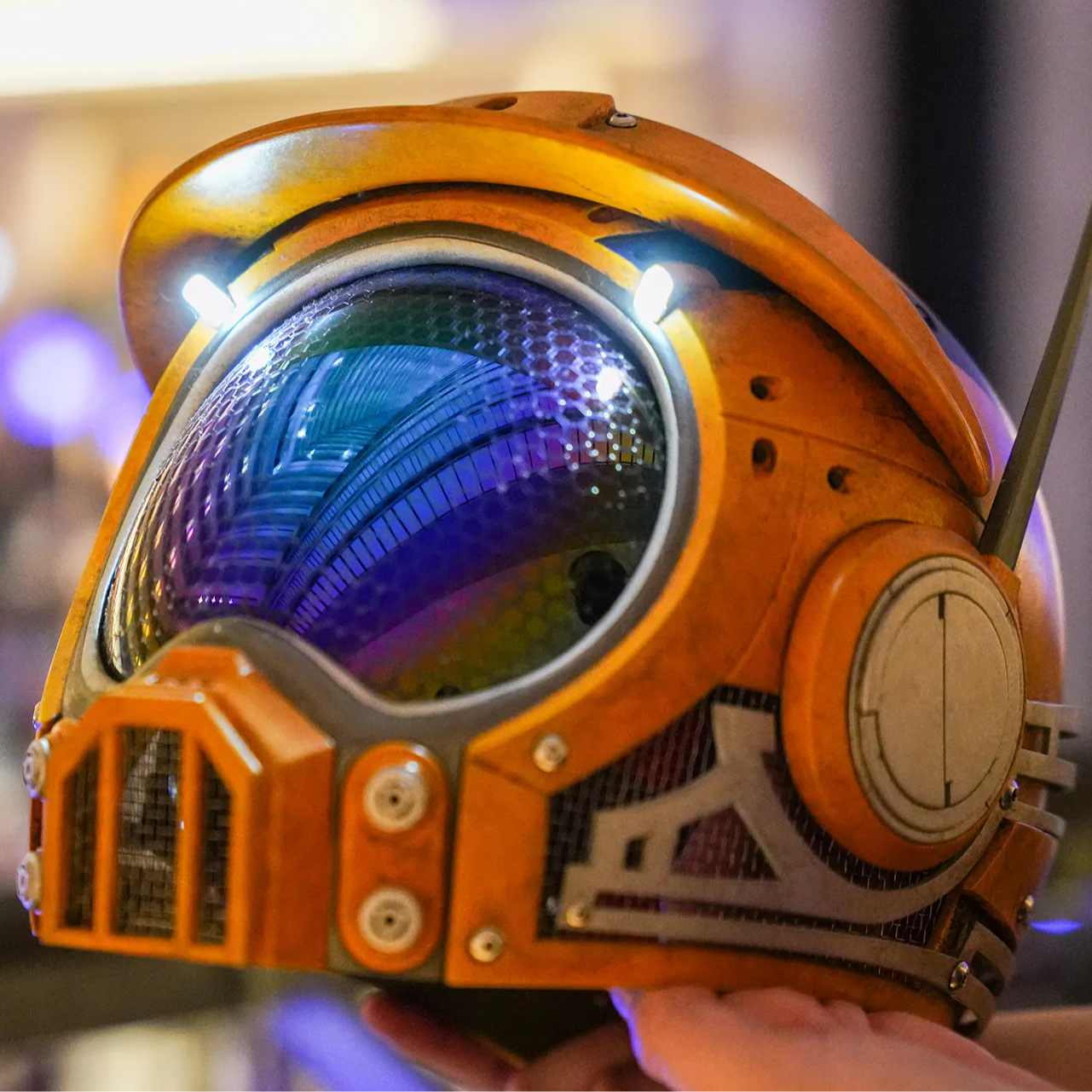
The hexagon grid pattern? It’s actually a clear vinyl sticker and doesn’t obstruct vision at all. Another clever touch.

With the helmet 3D printed, [GizmoThrill] heads to the bandsaw to cut away any excess from the visor, and secure it in place. That’s all there is to it! Sure, you don’t have full control over the visor’s actual shape, but it sure beats the tons and tons of sanding involved otherwise.

There’s a video tour of the whole process that shows off a number of other design features we really like. For example, metal mesh in the cheek areas and in front of the mouth means a fan can circulate air easily, so the one doesn’t fog up the inside of the visor with one’s very first breath. The mesh itself is concealed with some greebles mounted on top. You can see all those details up close in the video, embedded just below.

The helmet design is thanks to [Punished Props] and we’ve seen their work before. This trick for turning affordable and somewhat gimmicky sunglasses into something truly time-saving is definitely worth keeping in mind.

A Deep Dive Into Inductors

6 février 2026 à 03:00
A graph of current versus time for circuits with and without inductors

[Prof MAD] runs us through The Hidden Power of Inductors — Why Coils Resist Change.

The less often used of the passive components, the humble and mysterious inductor is the subject of this video. The essence of inductance is a conductor’s tendency to resist changes in current. When the current is steady it is invisible, but when current changes an inductor pushes back. The good old waterwheel analogy is given to explain what an inductor’s effect is like.

There are three things to notice about the effect of an inductor: increases in current are delayed, decreases in current are delayed, and when there is no change in current there is no noticeable effect. The inductor doesn’t resist current flow, but it does resist changes in current flow. This resistive effect only occurs when current is changing, and it is known as “inductive reactance”.

After explaining an inductor’s behavior the video digs into how a typical inductor coil actually achieves this. The basic idea is that the inductor stores energy in a magnetic field, and it takes some time to charge up or discharge this field, accounting for the delay in current that is seen.

There’s a warning about high voltages which can be seen when power to an inductor is suddenly cut off. Typically a circuit will include snubber circuits or flyback diodes to help manage such effects which can otherwise damage components or lead to electric shock.

[Prof MAD] spends the rest of the video with some math that explains how voltage across an inductor is proportional to the rate of change of current over time (the first derivative of current against time). The inductance can then be defined as a constant of proportionality (L). This is the voltage that appears across a coil when current changes by 1 ampere per second, opposing the change. The unit is the volt-second-per-ampere (VsA-1) which is known as the Henry, named in honor of the American physicist Joseph Henry.

Inductance can sometimes be put to good use in circuits, but just as often it is unwanted parasitic induction whose effects need to be mitigated, for more info see: Inductance In PCB Layout: The Good, The Bad, And The Fugly.

❌
❌