
Vue normale

Il y a de nouveaux articles disponibles, cliquez pour rafraîchir la page.
Aujourd’hui — 2 février 2026hackaday.com

Hackaday Links: February 1, 2026

Par : Tom Nardi
2 février 2026 à 00:00
Hackaday Links Column Banner

For many readers, more snow is the last thing they want to see right now…but what if it comes in the form of an online simulator in the style of an old DOS game? Created by [Potch], it works like one of those “falling sand” simulators, with sliders that let you control various elements of the wintry action. For more a immersive experience, open the window and let some cold air in while you play.

If those old school graphics have you yearning for a simpler time, then you’ll love Places to Telnet, a page on the very slick CRT-themed telnet.org that lists servers you can connect to. The list is made up primarily of games, but there’s also systems you can call up to do things like show the weather or browse Wikipedia. They even take submissions, so if you know any interesting destinations that aren’t on the list, make sure to share with the class.

Our ability to make and use tools is one of the things that separates us from the rest of the animal kingdom, and is an ability not often seen outside of primates. But a recent paper in Current Biology describes how one cow, Veronika, has been observed using a long-handled brush to scratch herself. Apparently the clever heifer will even flip the brush around and use the handle side when she wants to really dig in there. The paper says the findings “invite a reassessment of livestock cognition”, and points out that little serious research has been done on bovine intelligence in the 10,000 or so years since humans first domesticated them. We’re just happy this paper came out when it did — that way it will be a distant memory by the time we fire up the grill in the summer.

Get ready for Planet of the Cows

While the cows might be catching up to us, we’re still comfortably ahead of them in terms of spaceflight. Those eagerly awaiting humanity’s return to the Moon will have to wait a little longer however, as NASA has pushed back the wet dress rehearsal for Artemis II. This in turn has kicked the actual launch a few days farther down the road, and realistically, is probably the first of several delays as the space agency checks and re-checks the SLS rocket and Orion capsule before liftoff.

The launch rehearsal was supposed to start last night, but was delayed due to the unusually cold weather at the Cape — a wise precaution given the Shuttle-lineage of the SLS, especially as we’re just a few days past the 40th anniversary of the Challenger disaster.

While on the subject of returning to the Moon, Blue Origin has announced that they are pausing space tourism flights aboard their New Shepard rocket for at least two years so that they can better focus their energies on developing the Blue Moon lunar lander. It’s a bit hard to believe the two programs could have much overlap, or that the Jeff Bezos backed company doesn’t have the resources to pursue both simultaneously. Seems more likely that demand for suborbital joyrides isn’t what they hoped for, especially after the public backlash several of the celebrity passengers experienced after their flight. With Virgin Galactic still in the middle of their own multi-year pause on commercial flights, the entire sub-orbital tourism industry (such as it is) is effectively on hold for the time being.

Suborbital flights for the wealthy will likely return one day, but by the time you read this, Belkin will have permanently pulled the plug on almost all of their Wemo smart gadgets. While Belkin’s cloud services for the devices has now gone dark, they note that any devices in the wild that were configured to work with Thread or Apple’s HomeKit will continue to work in local mode. We’re no strangers to seeing IoT devices go belly-up, but the end of Wemo still feels significant. Introduced in 2011, they were an early success story in a now flooded market.

While the average Wemo owner is out of luck, there’s good news for hackers. Tools and libraries which interact with Wemo devices on the local network such as pywemo are reportedly unaffected by the cloud shutdown. So if you see any of these devices popping up on the second-hand market, or maybe even the trash, they can still be put to use. If you manage to rescue some of these smart gadgets from the landfill, make sure to let us know.


See something interesting that you think would be a good fit for our weekly Links column? Drop us a line, we’ve love to hear about it.
Fixing Sony and Philips’ Doomed CD-i Console

Par : Maya Posch
2 février 2026 à 03:00

Although not intended to be a game console, the CD-i would see a a couple of games released for it that would cement its position in gaming history as the butt of countless jokes, some of which still make Nintendo upset to this day. That aside, it’s still a fascinating glimpse at the CD-based multimedia future envisioned in the early 90s, starting with its release in 1990. Recently [MattKC] decided to purchase another CD-i in a fit of nostalgic rage, and repair it to show the world what the future could have been like.

Although Sony and Philips co-developed the device, Sony would go on to release the PlayStation a few years later, which made the CD-i’s life and expectations for it that much harder, leading to it slowly fading into history. The Magnavox one that [MattKC] got is one of the later models, based on the CD-i 450 that was introduced in 1994 as one of the more gaming-oriented models.

As is typical with older devices that use optical media, it would not read discs. It also would sometimes boot up with a ‘Memory Full’ error. This is a common fault due to the built-in battery having run out, erasing RAM-stored values and causing random glitches like this when garbage values were read in on boot.

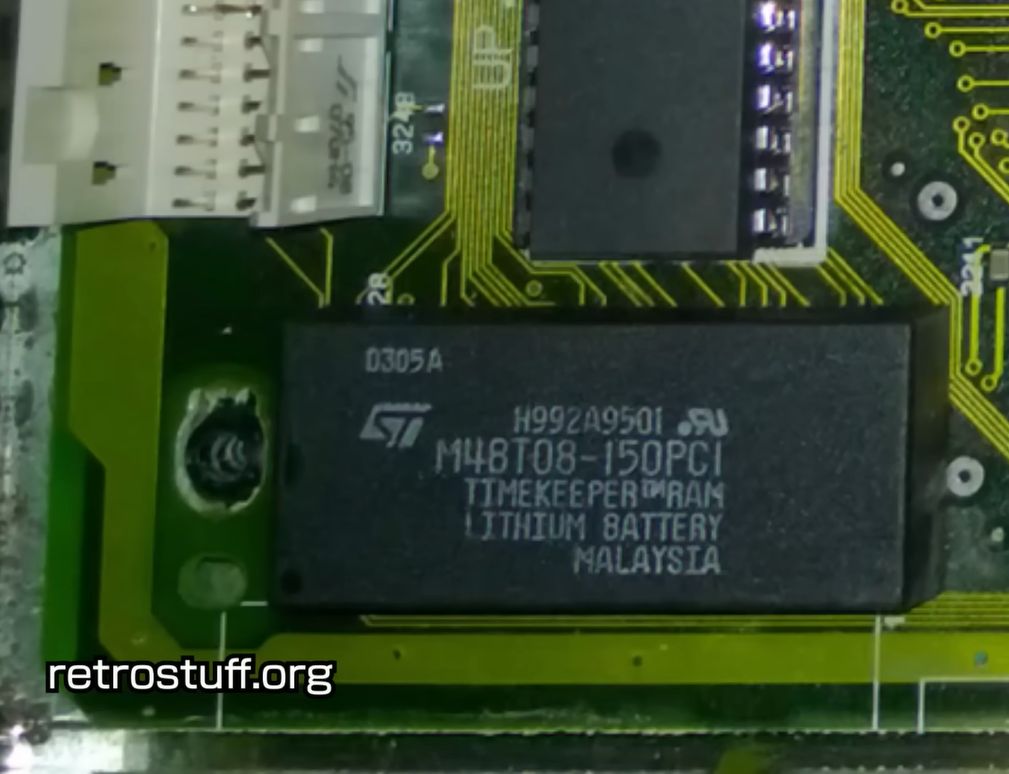
Of course, there cannot be simply a removable battery on the mainboard. Instead it uses one of those integrated battery-RAM units, specifically an ST Timekeeper device.

These use an internal lithium battery which will inevitably run out after the guaranteed ten-year accumulated memory retention period, after which it’s just typical volatile memory. The solution here is to either replace the entire module, or the more appropriate method of chopping it open and wiring up an external CR2032 coin cell that can be easily replaced.

Ultimately this is what [MattKC] opted for, taking a Dremel to the Timekeeper chip and chopping off the top half. There are open replacements for the top half that contain the crystal and the CR2032 cell holder, which makes it into very clean-looking mod, and makes replacing the lithium cell in the future a snap. Of course, this didn’t fix the CD player.

The CDM 12.1 CD player mechanism is a standard module that Philips used throughout its consumer electronics, and is known for failing. Funnily enough, this time it wasn’t the laser module that had failed, but rather a stuck turntable. A bit of prodding helped to loosen it and the mechanism could read CDs just fine again.

While not a popular series of devices in their day, the CD-i actually has a thriving community around it today, featuring countless mods and hacks to make these devices do things never imagined in the 90s. They’re also quite easy to hack, and relatively affordable. Plus you get to play all the amazing Nintendo titles on the CD-i on the real hardware.

CPU Scheduler Divines The Will Of The Heavens

Par : Lewin Day
2 février 2026 à 06:00

Horoscopes are a great way to pass a boring lunchbreak, and an excellent excuse for ending a ill-considered relationship. They’re also a hilarious way to handle CPU scheduling under Linux, thanks to the work of [Lucas Zampieri].

The project is called scx_horoscope, and it’s a sched_Ext scheduler that makes its CPU scheduling choices based on what the heavens are doing in real time. Different tasks are handled based on different astronomical objects. For example, the Sun represents life force, and thus grants boons to key system processes. The Moon, an emotive influence, rules over interactive processes like shells and terminals. Mercury, as the god of communication, handles network and IO tasks, and so it goes from there. It’s not just a surface level thing, either—[Lucas] has implemented the influences of the elements of fire, air, earth, and water, and there are negative timeslice penalties on associated tasks when a given planet lands in retrograde.

You can argue whether or not the broader motions of the heavens have any impact on our lives based on the time and circumstances of our birth. But you can’t argue that scx_horoscope really will influence how your computer runs based on the dance of the planets in the sky. Mostly, though, we concern ourselves with astronomy rather than astrology around these parts!

[Thanks to Benjamin for the tip!]

❌
❌