Vue normale

Il y a de nouveaux articles disponibles, cliquez pour rafraîchir la page.
Hier — 3 février 2026hackaday.com

Rewinding a Car Alternator for 240 Volt

Par : Maya Posch
3 février 2026 à 21:00
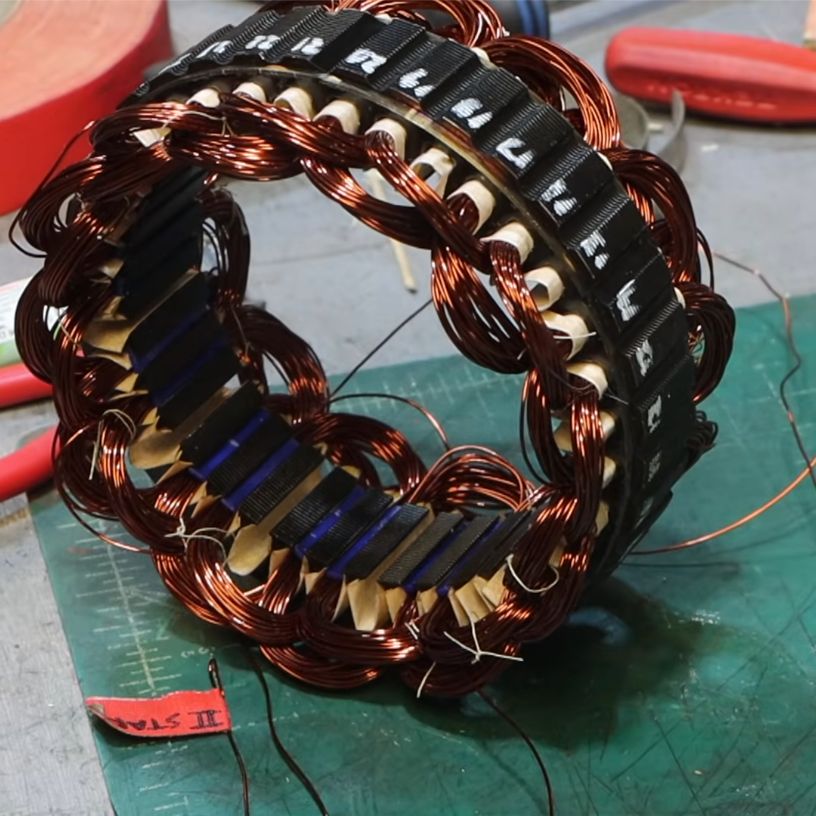
Two phases installed on the stator. (Credit: FarmCraft101, YouTube)

As part of his quest to find the best affordable generator for his DIY hydroelectric power system, [FarmCraft101] is trying out a range of off-the-shelf and DIY solutions, with in his most recent video trying his hands at the very relaxing activity of rewiring the stator of an alternator.

Normally car alternators output 12VDC after internal rectification, but due to the hundreds of meters from the turbine to the shed, he’d like a higher voltage to curb transmission losses. The easiest way to get a higher voltage out of a car alternator is to change up the wiring on the stator, which is definitely one of those highly educational tasks.

Disassembling an alternator is easy enough, but removing the copper windings from the stator is quite an ordeal, as they were not designed to ever move even a fraction of a millimeter after assembly.

With that arduous task finished, the rewinding was done using 22 AWG copper enamel wire, compared to the original 16 AWG wire, and increasing the loops per coil from 8 to 30. This rewinding isn’t too complicated if you know what you’re doing, with each coil on each of the three windings placed in an alternating fashion, matching the alternating South/North poles on the rotor.

Each phase’s winding is offset by two slots, leaving space for the other two phases, which then correspondingly are 90° out of phase when running, creating the three-phase AC output. This is further detailed in the video.

To make sure the windings do not short out on the stator, each slot has a bit of Nomex insulating paper placed into it, and a PETG 3D printed slot holder makes sure that none of the windings sneak out of their slot after installation.

The phases were connected in a Wye configuration, which gives it the maximum possible voltage rather than optimizing it for current as in a Delta configuration.

With the rewinding done, the alternator was reassembled, and the three-phase output of the new stator tested. After some trial and error it was able to do 200 VDC after passing it through an external rectifier, for a total of 700 Watt.

While not an unmitigated success, it seems quite possible to use this alternator as a higher-voltage generator with the hydro setup, especially after the upcoming replacement of the rotor’s electromagnet with neodymium magnets to further simplify it. As a bonus, if he ever needs to rebuild a broken alternator from scratch, rewinding a stator is now child’s play.

Aujourd’hui — 4 février 2026hackaday.com

Lego Typewriter Writes Plastic Letters

Par : Lewin Day
4 février 2026 à 00:00

Some time ago, Lego released a beautiful (and somewhat pricey) typewriter set that was modeled after one used by company founder Ole Kirk Kristiansen. To the disappointment of some, it doesn’t actually work—you can’t really write a letter with it. [Koenkun Bricks] decided to rectify this with their own functional design.

Right away, we’ll state that this is not a traditional typewriter. There are no off-the-shelf Lego components with embossed letters on them, so it wasn’t possible to make Lego type bars that could leave an impression on paper with the use of an inked ribbon. Instead, [Koenkun Bricks] decided to build a design that was Lego all the way down, right to the letters themselves. The complicated keyboard-actuated mechanism picks out flat letter tiles and punches them on to a flat Lego plate, creating a plastic document instead of a paper one.

It’s not perfect in operation. It has some issues unique to its mode of operation. Namely, the round letter tiles sometimes rotate the wrong way as they’re feeding through the typewriter’s mechanisms, so you get sideways letters on your finished document. It looks kind of cool, though. Outside of that, sometimes the letter pusher doesn’t quite seat the letter tiles fully on the document plate.

Overall, though, it’s a highly functional and impressive build. We’ve seen some other great DIY typewriters before, too, like this 3D printed build. Video after the break.

[Thanks to hn3000] for the tip!]

Optical Combs Help Radio Telescopes Work Together

Par : Maya Posch
4 février 2026 à 03:00

Very-long baseline interferometry (VLBI) is a technique in radio astronomy whereby multiple radio telescopes cooperate to bundle their received data and in effect create a much larger singular radio telescope. For this to work it is however essential to have exact timing and other relevant information to accurately match the signals from each individual radio telescope. As VLBI is used for increasingly higher ranges and bandwidths this makes synchronizing the signals much harder, but an optical frequency comb technique may offer a solution here.

In the paper by [Minji Hyun] et al. it’s detailed how they built the system and used it with the Korean VLBI Network (VLB) Yonsei radio telescope in Seoul as a proof of concept. This still uses the same hydrogen maser atomic clock as timing source, but with the optical transmission of the pulses a higher accuracy can be achieved, limited only by the photodiode on the receiving end.

In the demonstration up to 50 GHz was possible, but commercial 100 GHz photodiodes are available. It’s also possible to send additional signals via the fiber on different wavelengths for further functionality, all with the ultimately goal of better timing and adjustment for e.g. atmospheric fluctuations that can affect radio observations.

A VIC-20 Emulator In Your Browser

Par : Lewin Day
4 février 2026 à 06:00

The Commodore VIC-20 was a solid microcomputer that paved the way for the legendary Commodore 64 to come. If you’re a fan of the machine and want to revisit its glory days, you could hunt one down on an auction site and hope that it’s in working order. Or you could just emulate the VIC-20 in your browser thanks to the work of [Lance Ewing].

The project is called JVic—because it’s a VIC-20 emulator written in Java. It’s primarily intended for playing old VIC-20 games, and is designed with mobile devices front of mind—so it works well on a phone screen. You can enjoy the built-in library of games, or you can even direct JVic to boot up a ROM from a ZIP file hosted on a given URL or attached to a forum post. You can also install it on your own device rather than running it online, if so desired. [Lance] provides a range of setup options for running it locally or putting it on your own web server if that’s how you like to do things. Files are on Github for those eager to dive in.

We get lots of VIC-20 hacks around these parts. Even if it’s not the most popular machine that Commodore ever built, it’s certainly up there in the rankings. If you want to learn Forth, or even build a VIC-20 from scratch, we’ve explored that before. If you’ve got your own retrocomputer hacks kicking around, don’t hesitate to let us know!

[Thanks to Stephen Walters for the tip!]

❌
❌