
Vue normale

Il y a de nouveaux articles disponibles, cliquez pour rafraîchir la page.
Hier — 31 janvier 2026hackaday.com

Thomas Edison May Have Discovered Graphene

Par : Al Williams
31 janvier 2026 à 21:00

Thomas Edison is well known for his inventions (even if you don’t agree he invented all of them). However, he also occasionally invented things he didn’t understand, so they had to be reinvented again later. The latest example comes from researchers at Rice University. While building a replica light bulb, they found that Thomas Edison may have accidentally created graphene while testing the original article.

Today, we know that applying a voltage to a carbon-based resistor and heating it up to over 2,000 °C can create turbostratic graphene. Edison used a carbon-based filament and could heat it to over 2,000 °C.

This reminds us of how, in the 1880s, Edison observed current flowing in one direction through a test light bulb that included a plate. However, he thought it was just a curiosity. It would be up to Fleming, in 1904, to figure it out and understand what could be done with it.

Naturally, Edison wouldn’t have known to look for graphene, how to look for it, or what to do with it if he found it. But it does boggle the mind to think about graphene appearing many decades earlier. Or maybe it would still be looking for a killer use. Certainly, as the Rice researchers note, this is one of the easier ways to make graphene.
Aujourd’hui — 1 février 2026hackaday.com

Motorized Faders Make An Awesome Volume Mixer For Your PC

Par : Lewin Day
1 février 2026 à 00:00

These days, Windows has a moderately robust method for managing the volume across several applications. The only problem is that the controls for this are usually buried away. [CHWTT] found a way to make life easier by creating a physical mixer to handle volume levels instead.

The build relies on a piece of software called MIDI Mixer. It’s designed to control the volume levels of any application or audio device on a Windows system, and responds to MIDI commands. To suit this setup, [CHWTT] built a physical device to send the requisite MIDI commands to vary volume levels as desired. The build runs on an Arduino Micro. It’s set up to work with five motorized faders which are sold as replacements for the Behringer X32 mixer, which makes them very cheap to source. The motorized faders are driven by L293D motor controllers. There are also six additional push-buttons hooked up as well. The Micro reads the faders and sends the requisite MIDI commands to the attached PC over USB, and also moves the faders to different presets when commanded by the buttons.

If you’re a streamer, or just someone that often has multiple audio sources open at once, you might find a build like this remarkably useful. The use of motorized faders is a nice touch, too, easily allowing various presets to be recalled for different use cases.

We love seeing a build that goes to the effort to include motorized faders, there’s just something elegant and responsive about them.

Changing Print Layer Patterns to Increase Strength

1 février 2026 à 03:00
A wooden frame is shown with a scale pulling down on a 3D-printed part held in the frame. A phone on a stand is taking video of the part.

Dy default, the slicing software used for 3D printers has the printer first create the walls around the edges of a print, then goes back to deposit the infill pattern. [NeedItMakeIt], however, experimented with a different approach to line placement, and found significant strength improvements for some filaments.

The problem, as [NeedItMakeIt] identified with a thermal camera, is that laying down walls around a print gives the extruded plastic time to cool of. This means new plastic is being deposited onto an already-cooled surface, which reduces bonding strength. Instead, he used an aligned rectilinear fill pattern to print the solid parts. In this pattern, the printer is usually extruding filament right next to the filament it just deposited, which is still hot and therefore adheres better. The extrusion pattern is also aligned vertically, which might improve inter-layer bonding at the transition point.

To try it out, he printed a lever-type test piece, then recorded the amount of force it took to break a column free from the base. He tried it with a default fill pattern, aligned fill, and aligned fill with a single wall around the outside, and printed copies in PLA, plain PETG, and carbon fiber-reinforced PETG. He found that aligned fill improved strength in PLA and carbon fiber PETG, in both cases by about 46%, but led to worse performance in plain PETG. Strangely, the aligned fill with a single outside wall performed better than default for PLA, but worse than default in both forms of PETG. The takeaway seems to be that aligned fill improves layer adhesion when it’s lacking, but when adhesion is already good, as with PETG, it’s a weaker pattern overall.

Interesting, [MakeItPrintIt]’s test results fit in well with previous testing that found carbon fiber makes prints weaker. Another way to get stronger print fill patterns is with brick layers.

Lumafield Peers into the 18650 Battery

1 février 2026 à 06:00
Lumafield battery quality report cover page

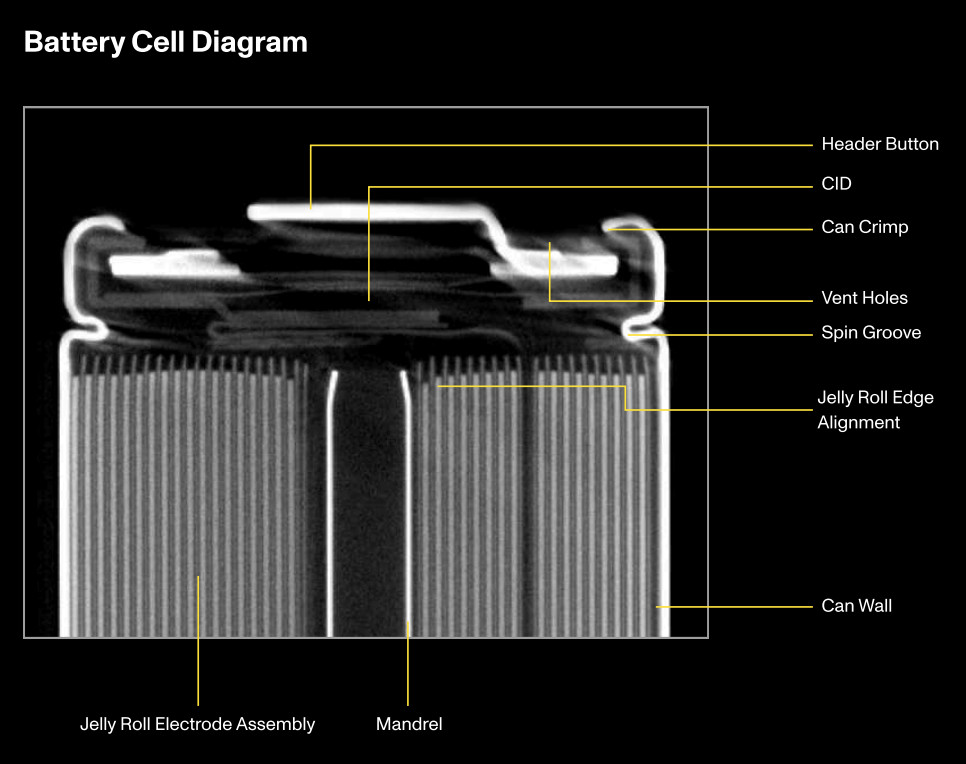
[Alex Hao] and [Andreas Bastian] of Lumafield recently visited with [Adam Savage] to share their battery quality report, which documents their findings after performing X-ray computed tomography scans on over 1,000 18650 lithium-ion batteries.

The short version — don’t buy cheap cells! The cheaper brands were found to have higher levels of manufacturing defects which can lead them to being unsafe. All the nitty-gritty details are available in the report, which can be downloaded for free from Lumafield, as well as the Tested video they did with [Adam] below.

Actually we’ve been talking here at Hackaday over at our virtual water-cooler (okay, okay, our Discord server) about how to store lithium-ion batteries and we learned about this cool bit of kit: the BAT-SAFE. Maybe check that out if you’re stickler for safety like us! (Thanks Maya Posch!)

We have of course heard from [Adam Savage] before, check out [Adam Savage] Giving A Speech About The Maker Movement and [Adam Savage]’s First Order Of Retrievability Tool Boxes.

❌
❌