Over the past couple of years with the Jenny’s Daily Drivers series, we’ve looked at a number of unusual or noteworthy operating systems. Among them has been ReactOS, an open source clone of a millennium-era Windows OS, which we tried back in November. It’s one of those slow-burn projects we know has been around for a long time, but still it’s a surprise to find we’ve reached the 30th anniversary of the first ReactOS code commit.
The post is a run through the project’s history, and having followed it for a long time we recognize some of the milestones from the various ISOs we downloaded and tried back in the day. At the end it looks into the future with plans to support more up-to-date hardware as well as UEFI, which we hope will keep it relevant.
When we tried it, we found an OS which could indeed be a Daily Driver on which a Hackaday article could be written — even if it wasn’t the slickest experience on the block. It doesn’t matter that it’s taken a while, if you’re used to Windows XP this has become a usable replacement. We came to the conclusion that like FreeDOS it could find a niche in places where people need a modern version of the old OS to run older software, but perhaps as it now moves towards its mature phase it will move beyond that. We salute the ReactOS developers for bringing it this far, and for not giving up.
The heat pump has become a common fixture in many parts of modern life. We now have reverse-cycle air conditioning, heat pump hot water systems, and even heat pump dryers. These home appliances have all been marketed as upgrades over simpler technologies from the past, and offer improved efficiency and performance for a somewhat-higher purchase price.
Heat pumps aren’t just for the home, though. They’re becoming an increasingly important part of major public works projects, as utility providers try to do ever more with ever less energy in an attempt to save the planet. These days, heat pumps are getting bigger, and will be doing ever grander things in years to come.
Magical Efficiency
The heat pump is a particularly attractive tool because it has a near-mystical property that virtually no other machine does. It is capable of delivering more heat energy than the amount of electricity fed into it, appearing to effectively have an efficiency greater than unity. We’re told that thermodynamic laws mean that we can never get more energy out than we put in. If you put 1 kW of electrical energy into a resistive heating element, which is near 100% efficient, you should get almost 1 kW of heat out of it, but never a hair more than that. But with a heat pump, you could get 1.5 kW, or even 2 kW for your humble 1 kW input. The trick is that the heat pump is not actually a magical device that can multiply energy out of nothing. Instead, the heat pump’s trick is that it’s not turning your 1 kW input into heat energy. It’s using 1 kW of energy to move heat from one place to another. If you’re running a heat pump-based HVAC system to cool your home, for example, it might use 2 kW of electricity to pump 3 to 4 kW of heat from your lounge room and dissipate it outdoors. Since the outdoors doesn’t change much in temperature when you pump out the heat from your home, you can keep doing this pretty much all day. You can even reverse the flow if your heat pump system allows it, instead pumping heat from the outdoors into your home. This works well until temperatures get so low that there isn’t enough heat left in the outdoors to appreciably warm your house up.
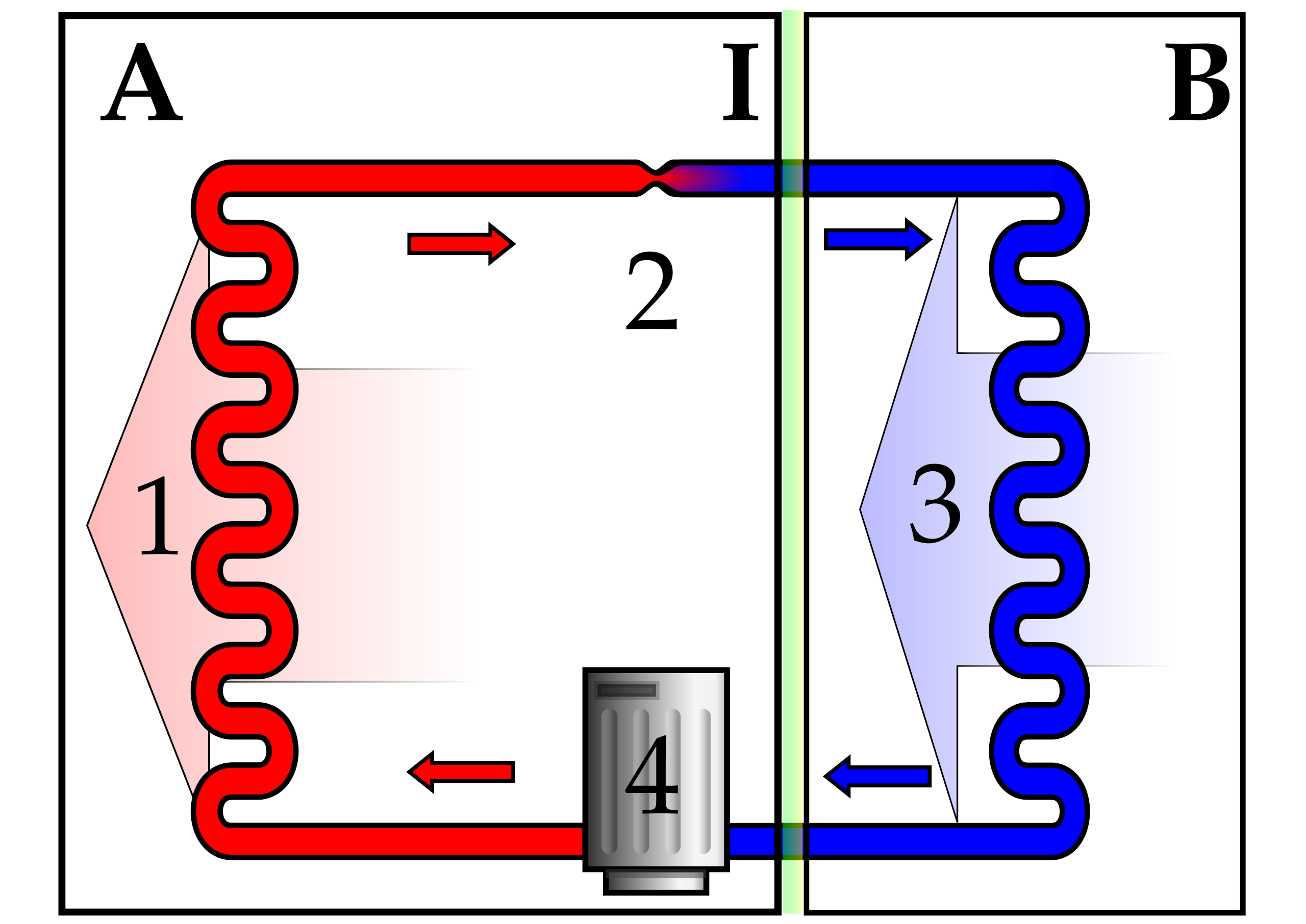
A diagram of a heat pump system. Heat is pumped from the outdoors (B) to the indoors (A), with insulation (I) in between. Note the condensor coils (1), the expansion valve (2), the evaporator coils (3), and the compressor (4). Credit: Ilmari Karonen, GFDL
The heat pump achieves the feat of making heat go where we want it to go via the use of refrigerant. Specifically, refrigerant enters the compressor as a low pressure and low temperature vapor. It exits as a gas at high temperature and high pressure, and is then passed through a series of condenser coils. As it passes through, it releases heat to the surrounding environment and reduces in temperature, condensing into a liquid. From there, the liquid, still under high pressure, passes through an expansion valve, which rapidly lowers the pressure and drops the temperature further. The liquid is now cold, and passes through an evaporator coil where it picks up heat from the surroundings and turns back into a low-pressure, low-temperature vapor to start the cycle again as it heads back to the compressor. This system runs your fridge, your car’s air conditioner, and is used in so many other applications where it’s desirable to make something colder or hotter as efficiently as possible. You just choose which direction you want to pump the heat and design the system accordingly. Air conditioners and fridges pump heat out of a confined space, heaters and dryers pump it in, and so on. It’s heat pumps all the way down!
Bigger Applications
Thus far, you’ve probably used many a heat pump in your daily life, whether it be for heating, cooling, or drying clothes. However, there is a new push to build ever-larger heat pumps to work on the municipal scale, rather than simply serving individual households. The hope is to make utilities more energy efficient, and thus cheaper and greener in turn, by taking advantage of the efficiency gains offered by the magic of the heat pump.
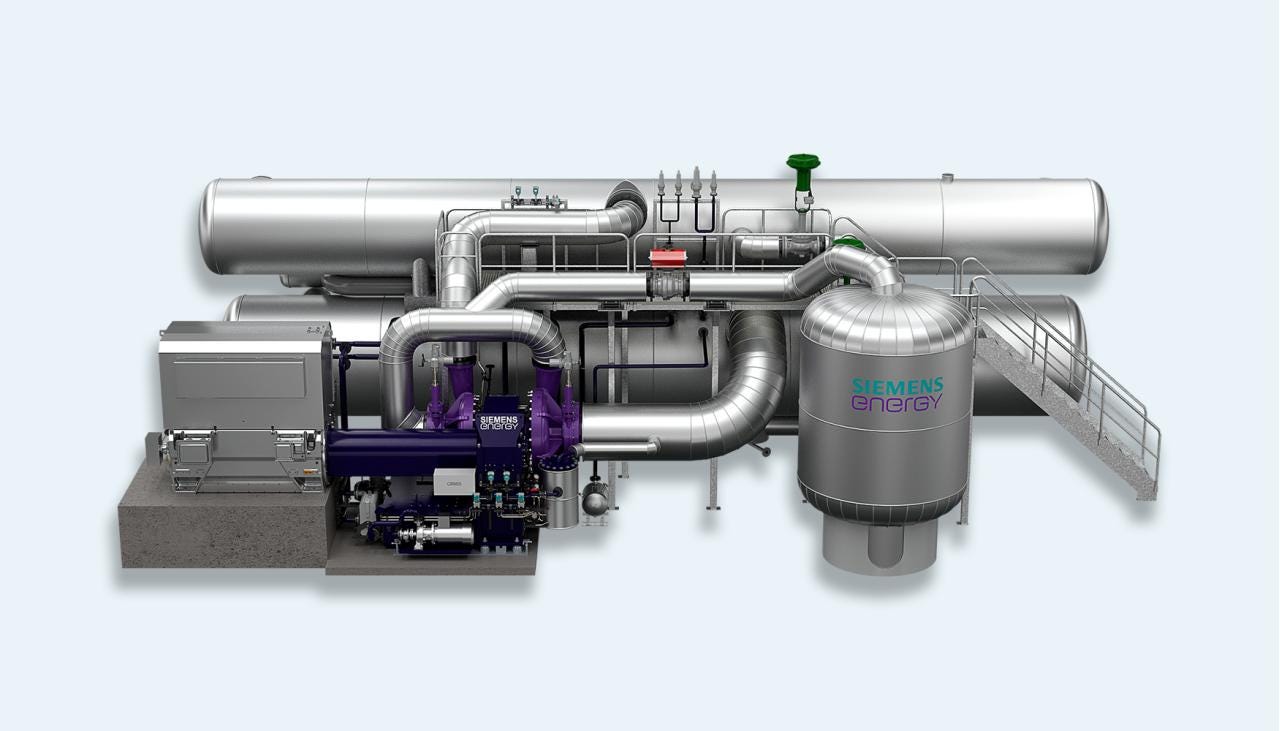
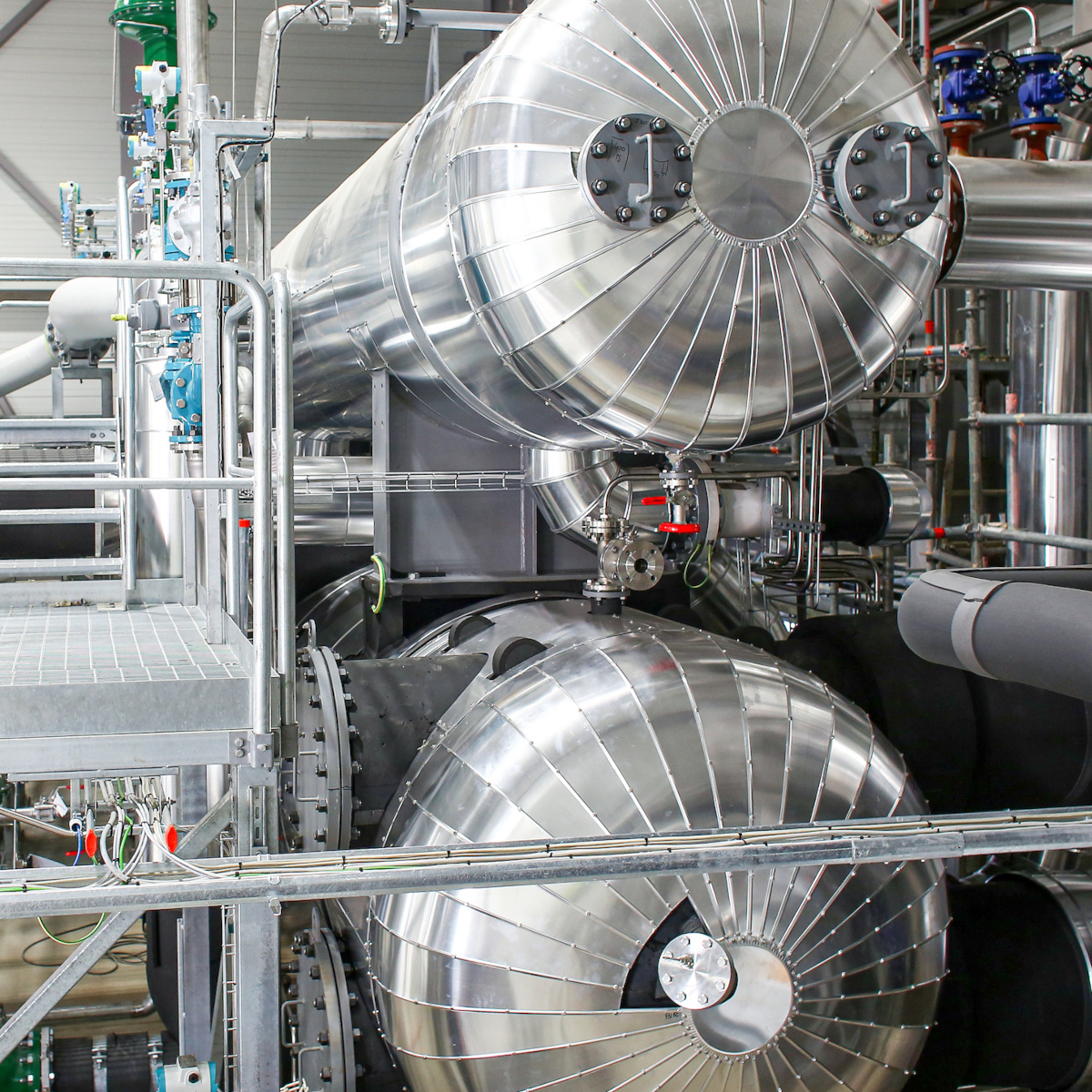
An earlier project saw Siemens Energy team up with MVV to install a heat pump system to supply 3,500 households with 20 megawatts of heat in Mannheim. The new installation will be almost an order of magnitude larger. Credit: SiemensAt 82.5 megawatts each, the new installation features what are perhaps the largest heat pumps in the world. Credit: MVV
One such project is taking place just off the River Rhine in Germany. A pair of massive heat pump units are being constructed by MVV Energie, each with a capacity of 82.5 megawatts. They will deliver heat to a total of 40,000 homes via a district heating system, and will be constructed on the site of a former coal power plant. Each pump will effectively draw energy out of the massive watery heat battery that is the River Rhine, and use it to warm homes in the local area. Thankfully, the river’s capacity is large enough that drawing all that heat out of the river should only affect temperatures of the water by around 0.1 C.
The Rhine project builds upon a previous effort to install a large heat-pump heating system in Mannheim, in partnership with Siemens Energy. That installation draws 7 megawatts of electricity to supply 20 megawatts of heating to the local district heating grid. Installed in 2023, it supplies the heating needs of 3,500 local households.
The Danish installation will use slightly smaller heat pumps, but more of them, for a combined output of 177 megawatts. Credit: MAN Technology
A similar project is underway in Denmark, which will supply 177 megawatts of heat to homes in Aalborg. The installation of four 44 megawatt MAN Technology heat pumps will be hooked up to the existing district heating system, which is also supported by other sources including waste heat from a local cement factory. The benefit of using smaller individual units is that it allows some of the pumps to be shut down when heating demand is lower, as winter passes through autumn into summer.
What makes these projects special is their sheer scale. Rather than being measured in the kilowatt scale like home appliances, they’re measured in the many tens of megawatts, delivering heating to entire neighborhoods instead of single homes. As it turns out, heat pumps work just fine at large scales—you just need to build them out of bigger components. Bigger compressors, bigger expansion valves, and bigger condensors and evaporators—all of these combine to let you pump enormous amounts of heat from one place to another. As utilities around the world seek ever greater efficiency in new projects, heat pumps will likely grow larger and be deployed ever more widely, seeking to take advantage of the free heat on offer in the earth, water, and air around us. After all, there’s no point dumping energy into making heat when you can just move some that’s already there!

 Connexion