
Vue normale

Il y a de nouveaux articles disponibles, cliquez pour rafraîchir la page.
Hier — 13 février 2026Flux principal

Custom Clamshell Cyberdeck Shows Off Underlighting

Par : Donald Papp
13 février 2026 à 19:30

Cyberdecks are great projects, and [Salim Benbouziyane]’s scratch-built CM Deck is a fantastic specimen. It’s a clamshell-style cyberdeck with custom split keyboard, trackpad, optional external WiFi antenna, and some slick underlighting thanks to a translucent bottom shell. There’s even a hidden feature that seems super handy for a cyberdeck: a special USB-C port that, when plugged in to another host (like another computer), lets the cyberdeck act as an external keyboard and trackpad for that downstream machine.
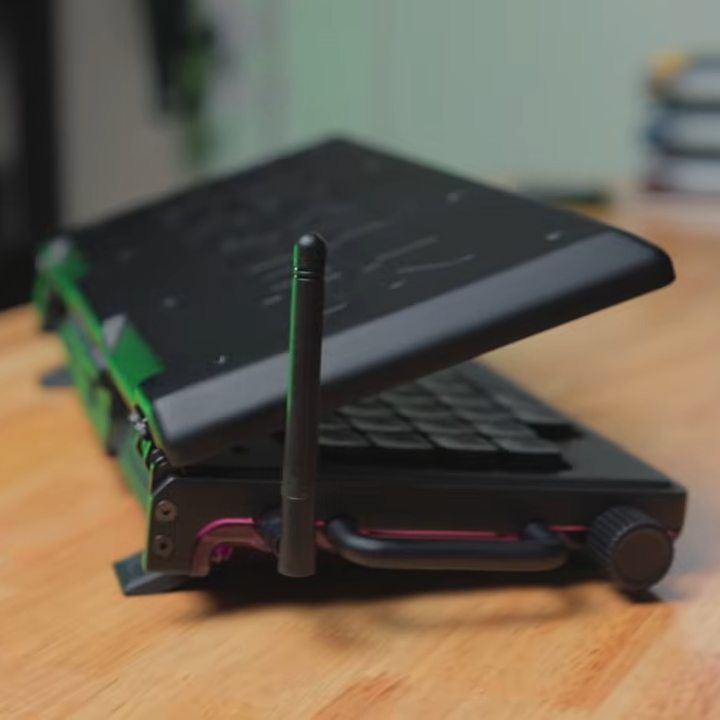
The CM Deck is built around the Raspberry Pi Compute Module 5, which necessitates a custom PCB but offers more design freedom.

Notably, the CM Deck is custom-built around the Raspberry Pi Compute Model 5. When we first peeped the CM5 the small size was striking, but of course that comes at the cost of having no connectors, supporting hardware, or heat management. That’s something [Salim] embraced because it meant being able to put connectors exactly where he wanted them, and not have to work around existing hardware. A custom PCB let him to lay out his cyberdeck with greater freedom, less wasted space, and ultimately integrate a custom-built keyboard (with RP2040 and QMK firmware).

Even the final enclosure is custom-made, with 3D printing being used to validate the design and PCBway providing finished plastic shells in addition to manufacturing the PCBs. [Salim] admits that doing so was an indulgence, but his delight at the quality of the translucent purple undercarriage is palpable.

[Salim]’s video (embedded below) is a deep dive into the whole design and build process, and it’s a great watch for anyone interested in the kind of work and decisions that go into making something like this. Experienced folks can expect to nod in sympathy when [Salim] highlights gotchas like doing CAD work based on the screen’s drawings, only to discover later that the physical unit doesn’t quite match.

The GitHub repository contains the design files for everything, so give it a browse if you’re interested. [Salim] is no stranger to clean builds, so take a moment to admire his CRT-style Raspberry Pi terminal as well.

Thanks [Keith Olson] for sharing the tip!
Aujourd’hui — 14 février 2026Flux principal

Rock Sphere Machine Produces Off the Charts Satisfaction

Par : Donald Papp
14 février 2026 à 06:00

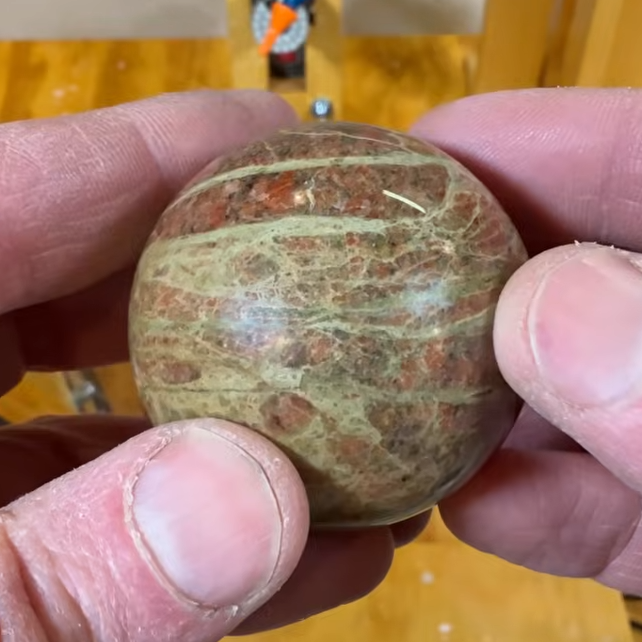
[Michigan Rocks] says he avoided making rock spheres for a long time on account of the time and cost he imagined was involved. Well, all that is in the past in light of the fabulous results from his self-built Rock Sphere Machine! Turns out that it’s neither costly to make such a machine, nor particularly time-consuming to create the spheres once things are dialed in. The video is a journey of the very first run of the machine, and it’s a great tour.

The resulting sphere? Super satisfying to hold and handle. The surface is beyond smooth, with an oil-like glossy shine that is utterly dry to the touch.

The basic concept — that of three cordless drills in tension — is adapted from existing designs, but the implementation is all his own. First a rough-cut rock is held between three diamond bits. The drills turn at 100 RPM while a simple water reservoir drips from above. After two hours, there’s a fair bit of slurry and the rock has definitely changed.

[Michigan Rocks] moves on to polishing, which uses the same setup but with progressively-finer grinding pads in place of the cutting bits. This part is also really clever, because the DIY polishing pads are great hacks in and of themselves. They’re made from little more than PVC pipe end caps with hex bolts as shafts. The end caps are filled with epoxy and topped with a slightly concave surface of hook-and-loop fastener. By doing this, he can cut up larger fuzzy-backed polishing pads and stick the pieces to his drill-mounted holders as needed, all the way down to 6000 grit. He shows everything about the pads at the 11:55 mark, and it’s an approach worth keeping in mind.

What is the end result like? See for yourself, but we think [Michigan Rocks] sums it up when he says “I wish you could feel this thing, it feels so smooth. It’s so satisfying to roll around in your hands. I’m so happy I made this machine. This is awesome.”

We’ve seen machines for making wooden spheres but this one makes fantastic use of repurposed stuff like inexpensive cordless drills, and the sort of wood structures anyone with access to hand tools can make.

Thanks to [AloofPenny] for the tip.

❌
❌