
 Connexion
Vue lecture
LummaStealer infections surge after CastleLoader malware campaigns
No Man's Sky Remnant update brings a fancy gravity gun and customizable trucks

Read the full article on GamingOnLinux.
Meet the poster boy & mom of the early AIDS epidemic: Bobbi Campbell & Zelda Rubinstein

In the early 1980s, as AIDS ravaged the gay community in the U.S., two people emerged as the first “poster boy” and “poster mom” of the epidemic — even as celebrities shied away from cause and people who were HIV-positive were hesitant to publicly disclose their diagnosis.
In December 1981, Bobbi Campbell, a nurse and gay rights activist in San Francisco, published the first of what would become a series of column in the city’s bi-weekly newspaper The Sentinel. “I’m Bobbi Campbell, and I have gay cancer,” he wrote, according to The Body.
Related
The amazing cases of 9 people “cured” of HIV each contain clues about a possible cure
Never Miss a Beat
Subscribe to our newsletter to stay ahead of the latest LGBTQ+ political news and insights.
Subscribe to our Newsletter today
As, Dr. Bill Lipsky noted in his 2022 remembrance for the San Francisco Bay Times, Campbell had been diagnosed with Kaposi’s sarcoma (KS) the previous October, becoming just the 16th person in the city to be diagnosed with the rare form of skin cancer that was suddenly popping up among young men. During those early days of the epidemic, before doctors identified HIV and AIDS, patients like Campbell were described as having “gay cancer.”
According to Lipsky, following his diagnosis, Campbell parlayed his experience as a nurse specializing in gay health issues into raising awareness about the so-called “gay cancer.”
“I’ve become so active in publicizing KS and the other gay illnesses to friends and media that I’ve taken to referring to myself sardonically as the ‘Kaposi’s Sarcoma Poster Boy,’” Campbell wrote in that first Sentinel column, titled “I Will Survive.”
According to The Body, Campbell’s column marked the first time anyone in the U.S. publicly disclosed their diagnosis of what would come to be known as AIDS. True to his self-styled nickname, Campbell created a poster featuring images of his own KS lesions — it included contact information for a University of California, San Francisco center tracking the disease. He hung the poster in the window of a Castro pharmacy. That poster is widely believed to be the first HIV/AIDS public service announcement, according to The Body.
Between 1981 and his death in August 1984, Campbell would work tirelessly to raise awareness about AIDS. He helped organize the Castro Street Dog Show and Parade, likely the world’s first AIDS fundraiser. In 1982, he co-produced Play Fair!, one of the first safer sex brochures for gay men, by gay men to focus on AIDS prevention.
That same year, he appeared on CBS News in one of the first national TV news segments to address AIDS. In 1983, Campbell was part of a group of people with AIDS at the Fifth Annual Lesbian and Gay Health Conference in Denver, Colorado who developed The Denver Principles, essentially a bill of rights for AIDS patients and a summary of responsibilities for the healthcare providers who cared for them.
Later that same year, he appeared on the August 8 cover of Newsweek embracing his partner, Bobby Hilliard, under the headline: “Gay America: Sex, Politics and the Impact of AIDS.”
Campbell “was very passionate and could be very angry, but he was also very funny,” Jones told The Body in 2024. “He’s remembered most for fighting as hard as he could on every front right up until the last weeks of his life.”
Following his 1984 death, the 1985 San Francisco Lesbian and Gay Freedom Day Parade was dedicated to Campbell.
Around the same time, another champion took up Campbell’s torch, becoming the “poster mother” in a campaign promoting HIV/AIDS prevention.
To most people, Zelda Rubinstein is probably best remembered as Tangina Barrons, the diminutive psychic in 1982’s Poltergeist and its two sequels. But to gay men in the mid-1980s, she was “Mother,” the star of a series of ads and television commercials aimed at raising awareness about HIV/AIDS and safer sex practices.
The charming, tongue-in-cheek ads depicted the four-foot, three-inch Rubinstein, then around 51 years old, as a loving mother figure, advising her “sons” — played by well-muscled, and often shirtless, male models — to “play safely” with other boys.
Rubinstein may not have had quite the same public profile as Elizabeth Taylor — who would not throw the full force of her fame behind HIV/AIDS activism until mid-1985 — but her involvement in the campaign marked one of the first times a celebrity of any stature lent their star power to the cause.
“At a time when few celebrities were willing to speak up, Zelda’s participation was nearly as groundbreaking as the first AIDS Walk itself,” AIDS Walk Los Angeles founder Craig R. Miller told the Windy City Times following her 2010 death at the age of 76. “She helped make the issue one that was not only accepted but embraced by the entertainment industry.”
“I lost a friend to AIDS, one of the first public figures that died of AIDS,” Rubinstein once told The Advocate, according to CNN’s 2010 obituary. “I knew it was not the kind of disease that would stay in anybody’s backyard. It would climb the fences, get over the fences into all of our homes. It was not limited to one group of people.”
Rubinstein was fortunately able to continue her advocacy far longer than Campbell. According to the Windy City Times, she worked for years with the L.A. Gay & Lesbian Center, AIDS Project Los Angeles, and promoted AIDS Walks. In August 2009, just months before her death, she told The Advocate that she would still “do a fundraiser for this cause anywhere in the world.”
“She was one of the very first Hollywood celebrities to speak out, and she was undaunted by the stigma that surrounded both the disease and those who spoke openly about it,” AIDS Project Los Angeles CEO Craig E. Thompson told the Windy City Times in 2019. “She wanted to make a difference, and she did.”
Subscribe to the LGBTQ Nation newsletter and be the first to know about the latest headlines shaping LGBTQ+ communities worldwide.
Proactive strategies for cyber resilience with Wazuh
REPLACED – Beta Sign Up
REPLACED is a 2.5D cinematic action platformer set in an alternate 1980s America reshaped by nuclear catastrophe.
In REPLACED, you play as R.E.A.C.H. – an AI trapped in a human body against its will. Phoenix-City has become a corporate stronghold where corruption thrives and human life is traded like currency. You’ll run, climb, and fight through crumbling districts, industrial wastelands, and neon-lit alleys with … Read More
The post REPLACED – Beta Sign Up first appeared on Alpha Beta Gamer.Motorola’s Password Pill Was Just One Idea

Let’s face it; remembering a bunch of passwords is the pits, and it’s just getting worse as time goes on. These days, you really ought to have a securely-generated key-smash password for everything. And at that point you need a password manager, but you still have to remember the password for that.
Well, Motorola is sympathetic to this problem, or at least they were in 2013 when they came up with the password pill. Motorola Mobility, who were owned by Google at the time, debuted it at the All Things Digital D11 tech conference in California. This was a future that hasn’t come to pass, for better or worse, but it was a fun thought experiment in near-futurism.
Dancing with DARPA
Back then, such bleeding-edge research was headed by former DARPA chief Regina Dugan. At the conference, Dugan stated that she was “working to fix the mechanical mismatch between humans and electronics” by doing things such as partnering with companies that “make authentication more human”.

Along with Proteus Digital Health, Dugan et. al created a pill with a small chip inside of it and a switch. Once swallowed, your various stomach acids serve as the electrolyte. The acids power the chip, and the switch goes on and off, creating an 18-bit ECG-like signal.
Basically, your entire body becomes an authentication token. Unlock your phone, your car door handle, and turn on your computer, just by existing near them.
It should be noted that Proteus already had FDA clearance for a medical device consisting of an ingestible sensor. The idea behind those is that medical staff can track when a patient has taken a pill based on the radio signal. Dugan said at the conference that it would be medically safe to ingest up to thirty of these pills per day for the rest of your life. Oh yeah, and she says the only thing that the pill exposes about the taker is whether they took it or not.
Motorola head Dennis Woodside stated that they had demonstrated this authentication technology working and authenticating a phone. While Motorola never intended to ship this pill, it was based on the Proteus device with FDA clearance, presumably so they could test it safely.
The story of Proteus Digital Health is beyond us here, but for whatever reason, their smart pills never took off. So we’re left to speculate about the impact on society that this past future of popping password pills would have had.
About That Government Influence
While it sounds sorta cool at first, it also seems like something a government might choose to force on a person sooner or later. Someone they wanted to insert behind enemy lines, perhaps, or just create an inside job that otherwise wouldn’t have happened.
Taking off my tin foil hat for a moment, I’ll compare this pill with existing modern biometrics. A face scan, a fingerprint, or even my voice is my passport, verify me are all momentary actions.
With these, you’re more or less in control of when authentication happens. A pill, on the other hand, must run its course. You can’t change the signal mid-digestive cycle. Plus, you’d have to guard your pills with your life, and if a couple pills pass through you every day, you’d better have a big pillbox.
Authentication Can Be Skin Deep
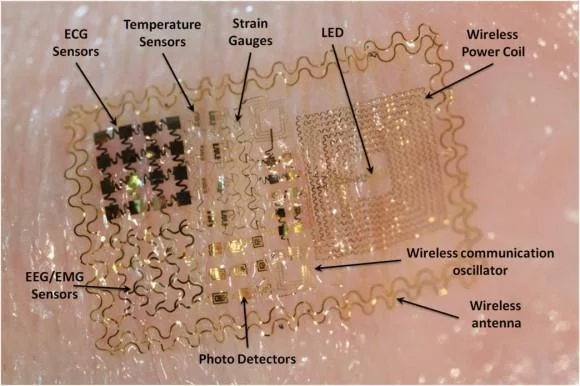
So the password pill never came to pass, but it’s worth mentioning that at the same conference, Dugan debuted another method of physical authentication — a temporary password tattoo they developed along with MC10, a company that makes stretchable circuits and has since been acquired by a company called Medidata.
More typically, their circuits are used to do things like concussion detection for sports, or baby thermometers that continuously track temperature.
Dugan said that the key MC10 technology is in the accordion-like structures connecting the islands of inflexible silicon. These structures can stretch up to 200% and still work just fine. The tattoos are waterproof, so go ahead and swim or shower. Of course, the password tattoo never came to be, either. And that’s just fine with me.
PFAS : près de Lyon, l’eau du robinet de deux communes contaminée aux « polluants éternels »
Attending GTC? Join The Register for an exclusive dinner on scaling AI data platforms
Learn about how tech leaders are scaling AI in practice
Promo AI projects fail at scale not because models don't work or GPUs lack performance. They fail because data can't keep pace.…
GitHub - tmilovan/composite-machine: Composite Machine: Automatic Calculus via Dimensional Arithmetic
Un mode de calcul des dérivées et intégrales qui me semble particulièrement intriguant. Si les performances sont raisonnables, ça peut apporter des éléments de performance très intéressants.
— Permalink
New Yorkers rally in solidarity with LGBTQ+ community after Trump ordered Stonewall Pride flag removed
 By the time dusk settled over Christopher Park in New York City’s Greenwich Village neighborhood on Tuesday, the narrow triangle of green across from the Stonewall Inn had become a small, loud commons. Rainbow flags were draped over shoulders. Chants rose and fell between the park’s statues. Attendees estimated that 500 to 750 people attended the protest against the National Park Service’s removal of the Pride flag from the Stonewall National Monument, a memorial dedicated to LGBTQ+ history.
 Fin de l’ère Le Pen ? Trois spécialistes de l’extrême droite décryptent l’hypothèse Bardella
Procès du RN : pourquoi Bardella n’en a pas fini avec les Le Pen
Mesa 26.0 is out bringing ray tracing performance improvements for AMD RADV
Read the full article on GamingOnLinux.
