Following the release of zlib-rs 0.6 last week, the developers behind this Rust-based Zlib implementation have declared their API stable and complete...
Un groupe de chercheurs balance des règles pour éviter que les algorithmes ne deviennent des boîtes noires ingérables qui foutent la merde en douce. Pas révolutionnaire, mais ça rappelle qu’on a besoin de garde-fous avant que tout parte en couilles 😒.
Comedian Megan Stalter has joined other celebrities in claiming TikTok is censoring anti-ICE videos.
The actress, who is best known for her role as Kayla in the HBO Max comedy series Hacks, spoke out about abolishing ICE and deleting TikTok after the fatal shootings of Renee Nicole Good and Alex Pretti in Minneapolis. Both were were killed during separate encounters with Immigration and Customs Enforcement (ICE).
On Monday (26 January), Stalter announced she is leaving the platform, citing that she believed it had censored anti-ICE videos she made.
She captioned the post: “I’ve tried for hours to upload the same video and it wouldn’t show it to one person. ABOLISH ICE! Delete TikTok!”
Stalter added in text over a photo of herself that she is downloading her videos and “deleting” her TikTok page because the app “is under new ownership and we are being completely censored and monitored”.
She also highlighted TikTok’s privacy policy, claiming that following its acquisition by an investor group headed by Trump ally and Oracle billionaire Larry Ellison, the app could collect sensitive information about its users, including if they’re trans or non-binary, as well as their citizenship or immigration status.
TechCrunch, however, noted that this language has been included in TikTok’s privacy policy since August 2024 and complies with “state privacy laws like California’s Consumer Privacy Act”.
Stalter isn’t alone in calling out TikTok, with Billie Eilish having claimed that her brother, Finneas, had his video calling out ICE censored. Eilish took to her Instagram Stories to share a screenshot of her brother’s anti-ICE TikTok video showing only 114 likes.
However, the video has seen received more views and over 473,000 likes.
We’re excited to announce that the Ruby Users Forum is officially live.
The forum is a new space for people who learn, use, and care about Ruby to ask questions, share resources, and have thoughtful discussions about the language and its ecosystem.
If you work with Ruby or are learning it, we’d love for you to join and help spread the word.
Gus Kenworthy has the skills needed to make it in the world of Heated Rivalry and might have also just put his best skate-wearing foot forwards to join the cast.
Speaking to The New Yorker recently Kenworthy discussed getting into the worldwide phenomenon. The interviewer also suggested that the athlete could be well suited for a part in season two.
Answering the interviewer’s suggestion Kenworthy then said: “You know, I played hockey through high school. I can skate, and I know how to handle a stick.”
In interviews, Connor Storrie and Hudson Williams, who play rival ice hockey players Ilya Rozanov and Shane Hollander respectively, have discussed coming into the roles without much skating experience.
Joining Late Night with Seth Meyersearlier this month, Storrie revealed the pair had “two weeks of skating training” prior to filming.
Hudson Williams and Connor Storrie in Heated Rivalry. (Sabrina Lantos/HBO)
So, hiring an actor with some actual skating experience could be a good thing for the show, allowing them to show off more hockey as well as more of the intimate moments the series has become famous for.
And there are number of roles Kenworthy could take on. We’ve had strong hints that Kyle (Matthew Finlan) could be a main character in season two. Kyle is the main character in the fourth Game Changers book, Common Goal. There he meets Scott’s teammate, Eric Bennett, a character not yet depicted in the TV series, potentially a good fit for Kenworthy.
Italy will be Kenworthy’s fourth Olympics. He won silver at the Sochi Winter Olympics in 2014 and also competed in PyeongChang (2018) and Beijing (2022).
U.S. Rep. Sarah McBride, Delaware’s at-large Democrat, on Monday demanded that federal immigration authorities immediately release Victor Acurio Suárez, a disabled Sussex County resident ordered deported last week.
Mosaica: Arboreal launches quietly arrives on Linux, Steam Deck, and Windows PC, inviting players into a nature-infused RPG puzzle adventure game. All made possible by the ongoing creative... Continue reading
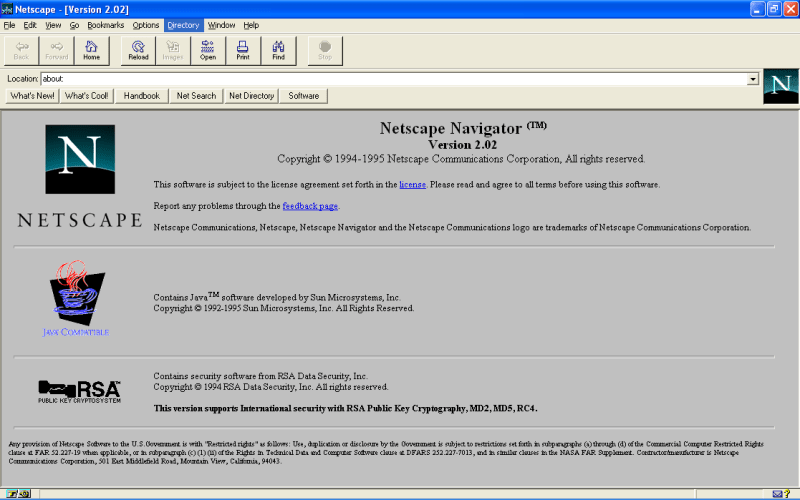
The very concept of the web browser began with a humble piece of software called NCSA Mosaic, all the way back in 1993. It was soon eclipsed by Netscape Navigator, and later Internet Explorer, which became the titans of the 1990s browser market. In turn, they too would falter. Navigator’s dying corpse ended up feeding what would become Mozilla Firefox, and Internet Explorer later morphed into the unexceptional browser known as Edge.
Few of us have had any reason to think about Netscape Navigator since its demise in 2008. And yet, the name lingers on. A zombie from a forgotten age, risen again to haunt us today.
The Bigger They Are, The Harder They Fall
Netscape Navigator was once the browser to use, dominating its rivals with a 90% market share. Unfortunately, that reign of glory only lasted until the last few years of the 1990s, when Internet Explorer began to embrace, extend, and extinguish. Explorer was included with every copy of Windows sold, it was distributed by AOL and minor ISPs alike, and it was better at keeping up with, or outright creating, new standards at a time when Netscape’s developers became stuck in the quagmire of an an increasingly aging codebase.
Netscape was great right through the 4.0s, but Netscape 5 was cancelled, and Netscape 6 was a mess. The company was bought out by AOL, and the product limped on into the early 2000s, but it was eventually declared dead on March 1, 2008. With almost no user base to speak of at that point, it simply did not make sense to continue.
You might think, then, that the Netscape name died with the browser and that it would never be seen or heard again. Unfortunately, that’s almost never the case when it comes to recognizable names in the tech world. Somebody always seems to hang on to the rights to do something with them, even if it’s usually unsuccessful. Sometimes it goes well, but more often than not, it amounts to little more than a hackneyed old logo slapped on a product that nobody really cares about.
Connect to the Internet by dialing up the Netscape ISP! Ironically founded several years after the browser ceased to be relevant at all. Credit: Netscape ISP via Web Archive
In the case of Netscape, the branding rights became AOL’s when it first purchased the business in 1998. It would go on to use the name to start a dial-up ISP in 2004, called Netscape Internet Service. It’s unclear precisely why this was done, given that AOL already was an ISP in its own right, which ran dial-up service all the way up until September 2025.
But for whatever reason, Netscape ISP kicked off operations on January 8, 2004, initially offering unlimited use for just $9.95 a month. Notably, it seems the name was the point—with the barebones site noting that you were getting a “reliable Internet connection from a name you trust.” It was also somewhat different from the contemporary AOL offering, in that you didn’t need a CD full of bloatware to access the service. The signup site went so far as to explain that you didn’t need to use a Netscape Navigator browser to access the service; any would do. As a cool bonus, you got a sweet “@netscape.com” email address when you signed up.
Even in 2016, the Netscape ISP was still offering dial-up connections only. However, you could get additional netscape.com email addresses for an extra $2.00 a month, along with various other add-ons of questionable value. Credit: Netscape ISP via Web Archive
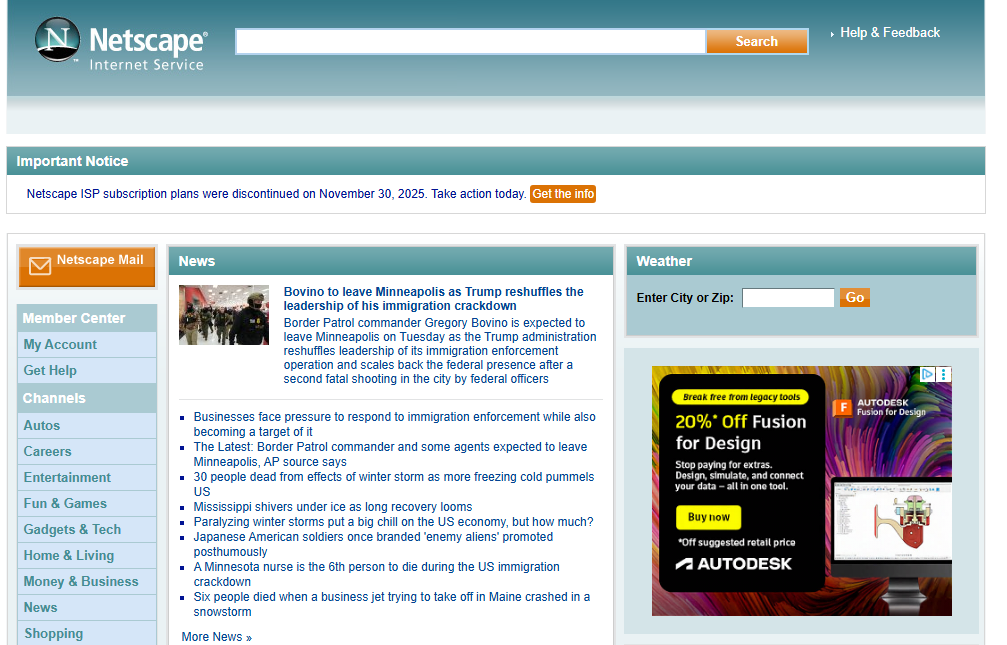
The Netscape ISP maintained its cheap offering for many years. It also later added “Web Accelerator,” which was a simple compression tool that promised to let you surf the web “up to 5x faster.” In reality, it was marketing fluff that did not make a lot of difference to dial-up users chugging along on slow connections. Weirdly, the Netscape ISP never transitioned over to selling DSL or fiber or any sort of modern broadband connection. As recently as 2018, you could still sign up for a service that was entirely dial-up only. Eventually, at some point in the late 2010s or early 2020s, Netscape ISP appeared to stop accepting new signups, with the main webpage (isp.netscape.com) eventually turning into a generic news aggregator. It remains in that state today at the time of writing.
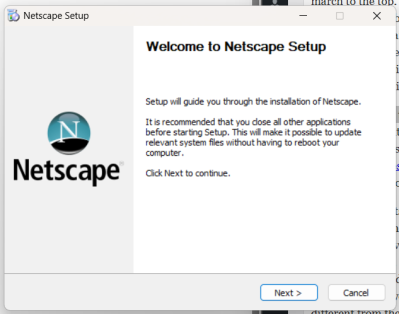
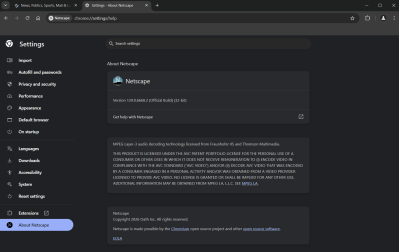
Perhaps the most hilarious part of the Netscape ISP story, though, is that it eventually spawned its own browser. Somewhere deep in the bowels of an AOL office, some poor developer had to hack together a Chromium fork to slap the Netscape ISP branding on it. You can still download it today, thanks to a link lurking on the bottom of the Netscape ISP site. We gave it a look.
The Netscape ISP page as it stands in 2026. This format has been used on the site since at least 2022; it appears the ISP stopped accepting new customers some years prior. Credit: isp.netscape.com
Hilariously, it’s an amalgamation of so many dying names from the early Internet—the privacy policy is hosted on Yahoo, because the now-defunct search engine merged with AOL in 2015. The browser is very obviously a reskinned version of Chromium from mid-2024, with a bit of AOL search bloatware thrown in for good measure.
While you can still download the silly 2024 “Netscape” browser, you can’t use the ISP anymore. That’s because AOL killed it dead in November 2025. Affected users will be able to maintain their super-cool netscape.com email addresses, but no more will you be able to dial up to access the Internet with your Netscape ISP account. To ease the change, AOL offered to transition affected users over to the “Complete by AOL” service, while also recommending alternatives like Starlink, HughesNet, Dialup4Less.com, and T-Mobile and Verizon 5G home internet plans. Yes, even in late 2025, your dying dial-up ISP was willing to recommend another that still operates on the old-fashioned phone lines, just as our ancestors intended.
One thing we’d love to see are the user statistics for the Netscape ISP over the past two decades. It’s hard to imagine there were a whole lot of people that were inconvenienced when AOL’s random off-shoot dial-up ISP went down in November 2025. It has to be some tiny figure, even less than the number of dial-up users that were still on the company’s main service, which shut down a month earlier. Still, they felt the need to issue a notice to users, so somebody must still have been calling in now and then, using their glacial 56K connection to check the weather and catch up on the latest updates in the Ivy League squash standings.
In any case, save for a tired old website and a rapidly-aging port of Chrome, Netscape is finally dead. For good this time. Until the logo turns up on a bunch of smart TVs and a badly-rebadged smartphone, or something. Until then, the big N shall hopefully be laid to rest.
Capgemini Government Solutions, filiale américaine de l’entreprise française, a signé plusieurs contrats avec l’ICE, l’agence américaine de l’immigration transformée par Trump en milice. Dans le dernier, il s’agit d’identifier et localiser des étrangers pour l’ICE, avec plusieurs millions de dollars à la clé. Capgemini Government Solutions, une filiale américaine de l’entreprise française, a répondu et […]

 Connexion






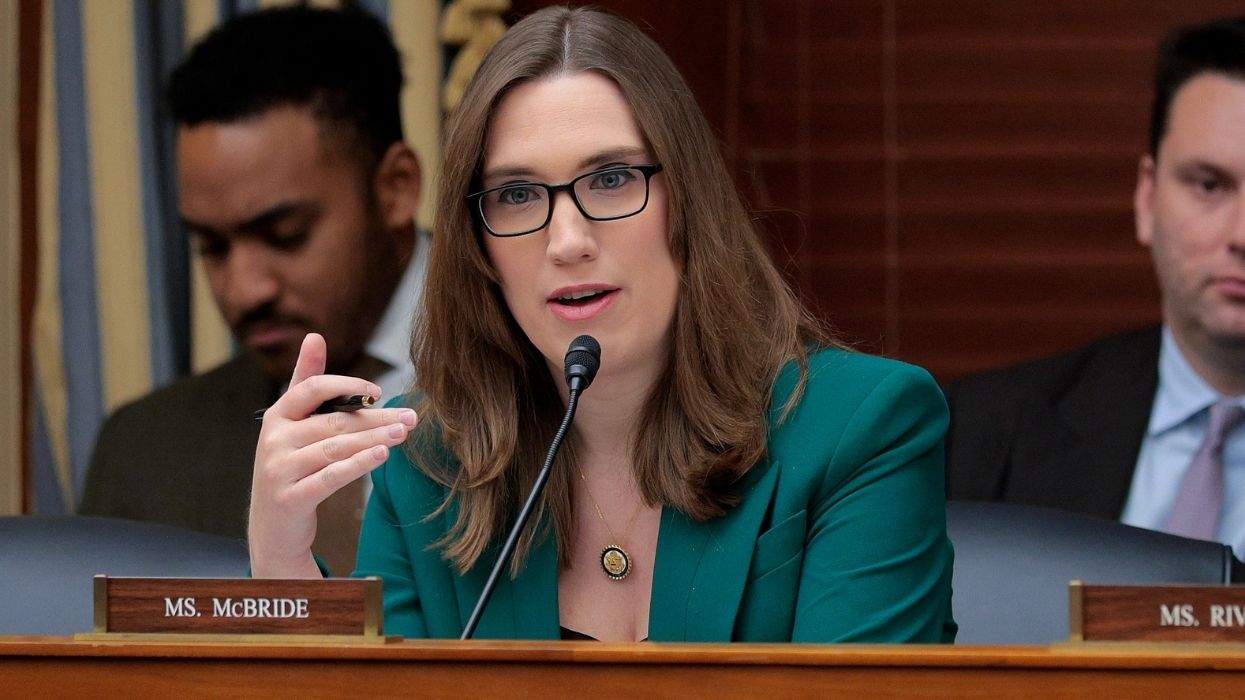 U.S. Rep. Sarah McBride, Delaware’s at-large Democrat, on Monday demanded that federal immigration authorities immediately release Victor Acurio Suárez, a disabled Sussex County resident ordered deported last week.