Vue lecture

Il y a de nouveaux articles disponibles, cliquez pour rafraîchir la page.

5K iMac Turned Into 5K Display

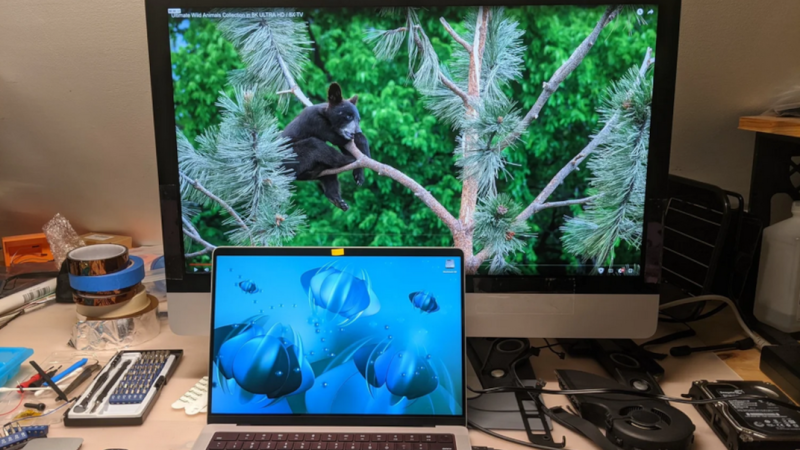
While Apple weren’t the first to invent high-DPI displays or to put them into consumer electronics, they did popularize them fairly effectively with the Retina displays in the early 2010s and made a huge number of them in the following years. The computers they’re attached to are getting up there in age, though, and although these displays are still functional it isn’t quite as straightforward to use them outside of their Apple-approved use. [David] demonstrates one way of getting this done by turning a 5k iMac into an external monitor.

The first attempt at getting a usable monitor from the old iMac was something called a Luna Display, but this didn’t have a satisfying latency. Instead, [David] turned to replacing the LCD driver board with a model called the R1811. This one had a number of problems including uneven backlighting, so he tried a second, less expensive board called the T18. This one only has 8-bit color instead of the 10-bit supported by the R1811 but [David] couldn’t personally tell the difference, and since it solved the other issues with the R1811 he went with this one. After mounting the new driver board and routing all of the wires, he also replaced the webcam with an external Logitech model and upgraded the speakers as well.

Even when counting the costs for both driver boards, the bill for this conversion comes in well under the cost of a new monitor of comparable quality from Apple, a company less concerned about innovation these days than overcharging their (admittedly willing) customers. For just a bit of effort, though, these older iMacs and other similar Apple machines with 5k displays can be repurposed to something relatively modern and still usable. Others have done similar projects and funded the upgrades by selling off the old parts.
Detecting Helium Leaks with Sound in a Physics-Based Sensor

Helium is inert, which makes it useful in a lot of different industries. But helium’s colorless and odorless non-reactivity also means traditional gas sensing methods don’t work. Specialized detectors exist, but are expensive and fussy. Thankfully, researcher [Li Fan] and colleagues found a physics-based method of detecting helium that seems as elegant as it is simple.

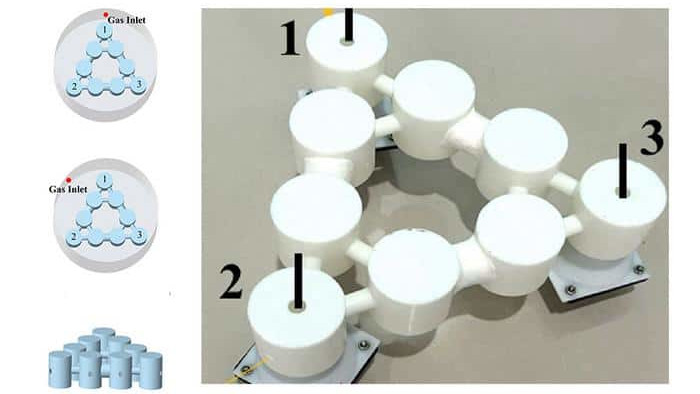
The new sensor relies on a topological kagome structure, and doesn’t depend on any chemical reaction or process whatsoever. The cylinders in the structure are interconnected; air can flow in and speakers at the three corners inject sound.

Sound waves propagate through the air within the structure at a fixed rate, and as helium enters the sensor it changes how fast the sound waves travel. This measurable shift in vibration frequency indicates the concentration of helium. It’s stable, calibration-free, doesn’t care much about temperature, and resets quickly. Even better, the three corners act as separate sensors, making it directional. It’s even quite rugged. Just as a basket weaved in a kagome pattern is stable and resistant to damage or imperfections in the individual strips that make up the pattern, so too is this sensor only marginally affected by physical defects.

The sensor design has been tested and shown to work with helium, but could possibly be applied to other gases. More detail is available at ResearchGate, with some information about the math behind it all in a supplemental paper.

Restoring the Soul of a 1940s Radio

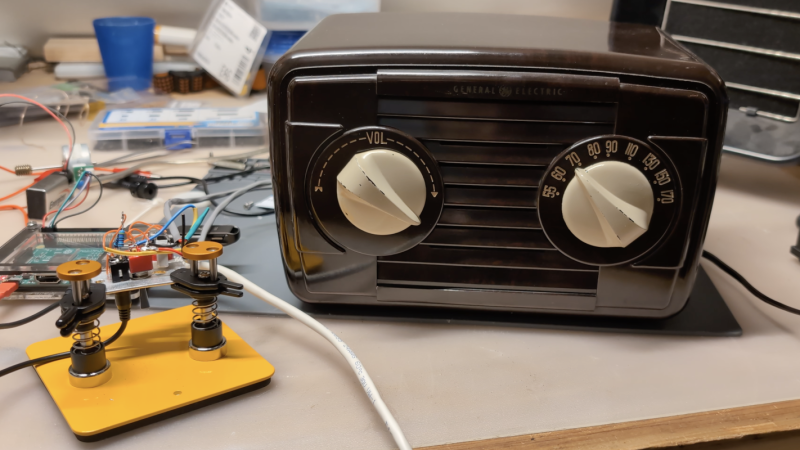
Although we do often see projects that take antiques and replace some or all of their components with modern equipment, we can also sympathize with the view that (when possible and practical) certain antique electronics should be restored rather than gutted. [David] has this inclination for his 1948 GE radio, but there are a few issues with it that prevented a complete, period-correct restoration.

The main (pun intended) issue at the start of this project was safety. The original radio had a chassis that was just as likely as not to become energized, with the only protection being the plastic housing. [David] set up an isolation transformer with a modern polarized power cable to help solve this issue, and then got to work replacing ancient capacitors. With a few other minor issues squared away this is all it took to get the radio working to receive AM radio, and he also was able to make a small modification to allow the radio to accept audio via a 3.5mm jack as well.

However, [David] also has the view that a period-correct AM transmission should accompany this radio as well and set about with the second bit of this project. It’s an adaptation of a project called FieldStation42 originally meant to replicate the experience of cable TV, but [Shane], the project’s creator, helped [David] get it set up for audio as well. A notable feature of this system is that when the user tunes away from one station, it isn’t simply paused, but instead allowed to continue playing as if real time is passing in the simulated radio world.

Although there are a few modern conveniences here for safety and for period-correct immersion, we think this project really hits the nail on the head for preserving everything possible while not rolling the dice with 40s-era safety standards. There’s also a GitHub page with some more info that [David] hopes to add to in the near future. This restoration of a radio only one year newer has a similar feel, and there are also guides for a more broad category of radio restorations as well.

❌