
Vue lecture

Il y a de nouveaux articles disponibles, cliquez pour rafraîchir la page.

Smoothie Bikes Turned Into Game Controllers
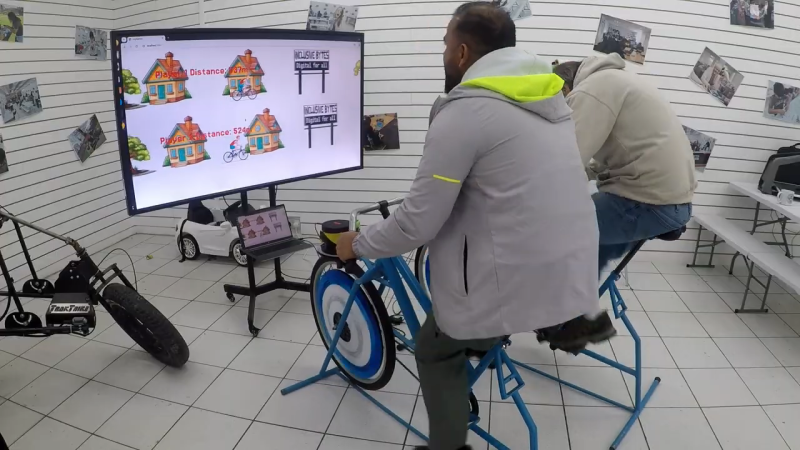
Smoothie bikes are a great way to make a nutritious beverage while getting a workout at the same time. [Tony Goacher] was approached by a local college, though, which had a problem with this technology. Namely, that students were using them and leaving them filthy. They posed a simple question—could these bikes become something else?

[Tony’s] solution was simple—the bikes would be turned into game controllers. This was easily achieved by fitting a bi-color disc into the blender assembly. As the wheel on the bike turns, it spins up the blender, with the disc inside. An ESP32 microcontroller paired with a light sensor is then able to count pulses as the disc spins, getting a readout of the blender’s current RPM. Working backwards, this can then be calculated out into the bike’s simulated road speed and used to play a basic game on an attached Raspberry Pi. Notably, the rig is setup such that the Raspberry Pi and one bike connect to an access point hosted by the other bike.  This is helpful, because it means neither bike has too many dangling cables that could get caught up in a wheel or chain.

We’ve seen many amusing game peripherals over the years, from salad spinners to turntables. Video after the break.


How HP Calculators Communicate Over Infrared

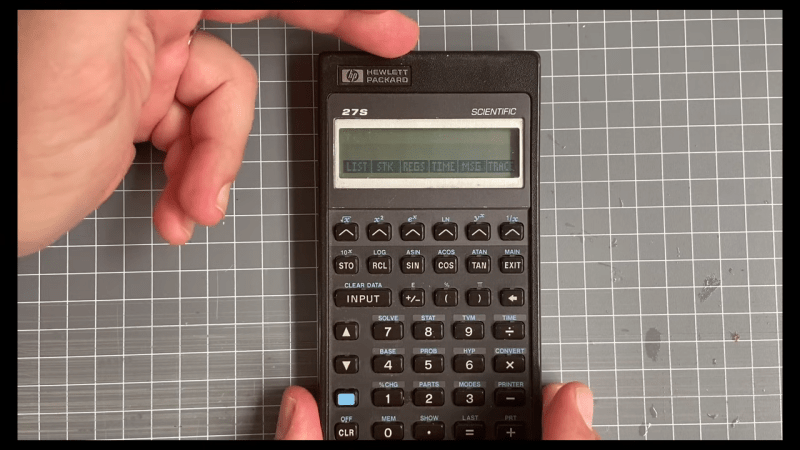
For most people, calculators are cheap and simple devices used for little more than addition and the odd multiplication job. However, when you get into scientific and graphical calculators, the feature sets get a lot more interesting. For example, [Ready? Z80] has this excellent explainer on how HP’s older calculators handle infrared communications.

The video focuses on the HP 27S Scientific Calculator, which [Ready? Z80] found in an op-shop for just $5. Introduced in 1988, the HP-27S had the ability to dump screen data over an infrared link to a thermal printer to produce paper records of mundane high-school calculations or important engineering math. In the video, [Ready? Z80] explains the communication method with the aid of Hewlett-Packard’s own journal publication from October 1987, which lays out of the details of “the REDEYE Protocol.” Edgy stuff. It’s pretty straightforward to understand, with the calculator sending out bursts of data in six to eight pulses at a time, modulated onto a 32.768KHz square wave as is the norm. [Ready? Z80] then goes a step further, whipping up custom hardware to receive the signal and display the resulting data on a serial terminal. This is achieved with a TEC-1G single-board computer, based on the Z80 CPU, because that’s how [Ready? Z80] does things.

We’ve seen other great stuff from this channel before, too. For example, if you’ve ever wanted to multitask on the Z80, it’s entirely possible with the right techniques. Video after the break.

❌