Vue lecture

Il y a de nouveaux articles disponibles, cliquez pour rafraîchir la page.

Making a Hidden Door Status Sensor

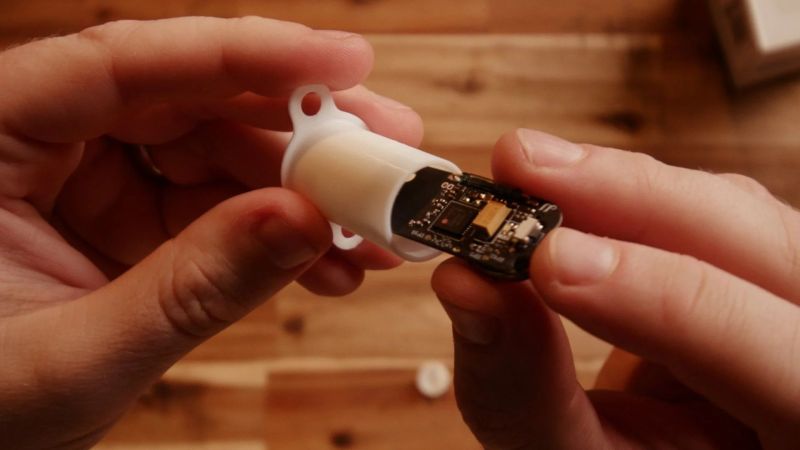
The door sensor in its new enclosures. (Credit: Dillan Stock)

A common sight in ‘smart homes’, door sensors allow you to detect whether a door is closed or open, enabling the triggering of specific events. Unfortunately, most solutions for these sensors are relatively bulky and hard to miss, making them a bit of a eyesore. This was the case for [Dillan Stock] as well, who decided that he could definitely have a smart home, yet not have warts sticking out on every single doorframe and door. There’s also a video version of the linked blog post.

These door sensors tend to be very simple devices, usually just a magnet and a reed relay, the latter signaling a status change to the wireless transmitter or transceiver. Although [Dillan] had come across recessed door sensors before, like a Z-wave-based unit from Aeotec, this was a very poorly designed product with serious reliability issues.

That’s when [Dillan] realized that he could simply take the PCB from one of the Aqara T1 door sensors that he already had and stuff them into a similar 20 mm diameter form factor as that dodgy sensor unit. Basically this just stuffs the magnet and PCB from an existing wart-style sensor into a recessed form factor, making it a very straightforward hack, that only requires printing the housings for the Aqara T1 sensor and some intimate time between the door and a drill.

The Complex Engineering of Runways

Airport runways seem pretty simple, just another strip of asphalt or concrete not unlike the roads that our cars drive upon every day. We can even use these same highways as landing strips in a pinch, so you’d assume that the engineering for either isn’t that dissimilar. Of course, you can use a highway for an occasional emergency, but a runway that sees the largest and heaviest airplanes taxi, take off and land on a constant basis is a whole other challenge, as detailed in a recent [Practical Engineering] video and its transcript.

When you consider that an Airbus A380 the take-off weight is up to 550 ton, it’s quite clear what the challenge is for larger airports. Another major issue is that of friction, or lack thereof, as the speeds and kinetic energy behind it are so much higher. One only has to look at not only runway overruns but also when one skids off sideways due issues like hydroplaning and uneven friction. Keeping the surface of a runway as high-friction as possible and intact after hundreds of take-offs, tail-strikes and other events is no small feat.

Of course, the other part of runway engineering is for when things do go wrong and an airplane enters the runway safety areas, or overrun zones. This usually provides some flat and clear space where an airplane can safely bleed off its kinetic energy, with the collapsing surface of the EMAS technology being one of the best demonstrations of how this can be safely and dramatically shortened.

Another aspect not covered here that is part of these overrun zones are frangible structures, such as any localizer antennae of ILS, lighting, etc. Frangible here means that the structure easily collapses when a heavy airplane crashes into it without causing significant damage to the airplane.

It was the failure of such a design process that doomed the crew and passengers of Jeju Air Flight 2216 in December of 2024, when the airplane during an emergency belly landing skidded over the end of the runway. Although there was a lot of open space after the ILS localizer array with just a flimsy wall and further level fields, the ILS array’s base contained a poured concrete base on which the airplane effectively pulverized.

❌