Vue lecture

Il y a de nouveaux articles disponibles, cliquez pour rafraîchir la page.

Solar Supercapacitor Lamp Probably Won’t Get You Saved At Sea
Most solar lights are cheap garbage that exist just to put more microplastics into the environment as they degrade in short order. [Jeremy Cook] built his own solar light, however, and this one might just last a little longer.

Most solar lights rely on the cheapest nickel-cadmium or nickel-metal hydride cells that are available on the market. They don’t tend to have a lot of capacity and they wear out incredibly fast. [Jeremy] went a different route for his build, though, instead relying on a rather tasty supercapacitor to store energy. Unlike a rechargeable battery, that may only last a few thousand cycles, these supercaps are expected to perform over 500,000 charge/discharge cycles without failure. With such longevity, [Jeremy] suggests his build could last a full 1369.8 years, assuming it charged and discharged once a day. Whether the plastic transistor, LEDs, or diode could hold up over such a long period is another question entirely.

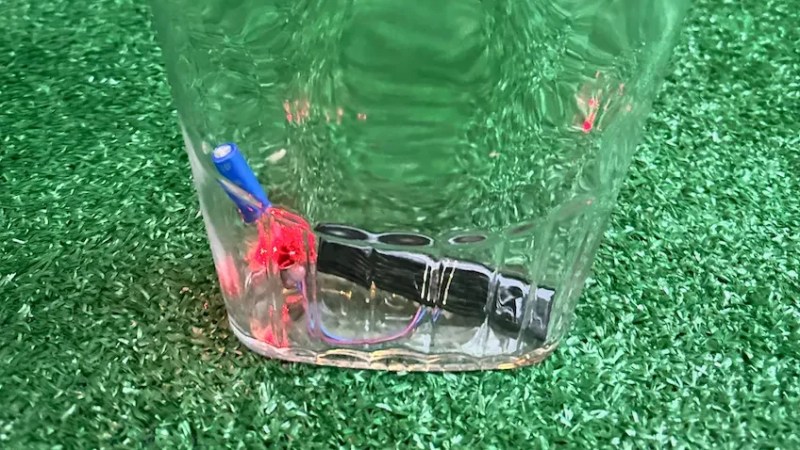
Electronically, the build is relatively simple. The solar panel collects light energy and turns it into electricity, charging the supercaps through a diode. The supercaps are only able to discharge through a transistor, which only turns on when the voltage output by the solar panel drops at night time, and the voltage on the base becomes lower than that on the emitter. When current flows through the transistor, it then lights the LED in turn and the device glows in the darkness. As a nice touch, the whole circuit is installed in a glass jug of syrup originally sourced from Costco. Files are on Github for those eager to explore further.

Given the light-in-a-bottle construction, [Jeremy] also playfully imagined that a lamp like this could theoretically be used as a safety device. If lost at sea, you could charge it using the sun and try and use it to signal for help. However, upon casually exploring the concept, he notes that a small solar-powered light will only raise the chance of a far-off ocean rescue from “extremely unlikely” to “still very unlikely.”

You can do all kinds of neat things with free energy from the sun, from mowing your lawn to processing waste products. Video after the break.

Rare-Earth-Free Magnets With High Entropy Borides

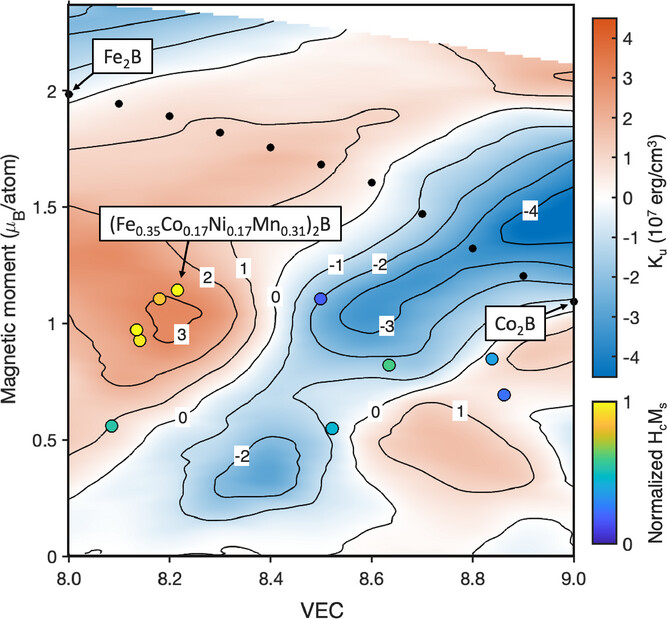
Map of the calculated magnetic anisotropy. (Credit: Beeson et al., Adv. Mat., 2025)

Although most of us simultaneously accept the premise that magnets are quite literally everywhere and that few people know how they work, a major problem with magnets today is that they tend to rely on so-called rare-earth elements. Although firmly in the top 5 of misnomers, these abundant elements are hard to mine and isolate, which means that finding alternatives to their use is much desired. Fortunately the field of high entropy alloys (HEAs) offers hope here, with [Beeson] and colleagues recently demonstrating a rare-earth-free material that could be used for magnets.

Although many materials can be magnetic, to make a good magnet you need the material in question to be both magnetically anisotropic and posses a clear easy axis. This basically means a material that has strong preferential magnetic directions, with the easy axis being the orientation which is the most energetically favorable.

Through experimental validation with magnetic coercion it was determined that of the tested boride films, the (FeCoNiMn)2B variant with a specific deposition order showed the strongest anisotropy. What is interesting in this study is how much the way that the elements are added and in which way determines the final properties of the boride, which is one of the reasons why HEAs are such a hot topic of research currently.

Of course, this is just an early proof-of-concept, but it shows the promise of HEAs when it comes to replacing other types of anisotropic materials, in particular where – as noted in the paper – normally rare-earths are added to gain the properties that these researchers achieved without these elements being required.

Lazarustorm Lets a PiStorm Live Outside Your Old Amiga

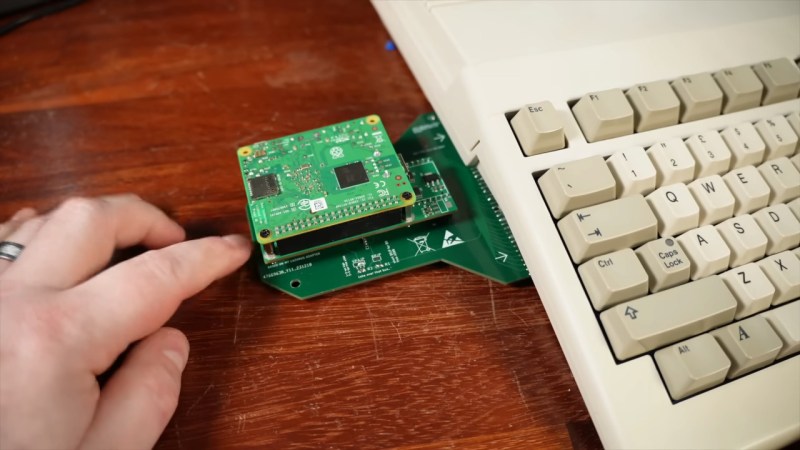
The PiStorm is nothing new; if you’re familiar with the retrocomputer scene, you’ve probably heard of it. By replacing the 68k processor in an old Amiga (or some models of Atari) the PiStorm accelerator gives a multiple order of magnitude speedup. It’s even a reversable mod, plugging in where the original CPU was. What’s not to love? Well, some people would simply prefer to keep their original CPUs in place. [TME Retro] has a video highlighting the solution for those people: the Lazarustorm by [arananet].

It makes perfect sense to us– back in the day, you could plug a whole x86 PC-compatible ‘sidecar’ into your Amiga, so why not a PiStorm? The whole bus is right there for the taking.The Lazarusstorm, as a project, is bog simple compared to the PiStorm itself. A PCB and the connectors to get it plugged into the expansion port on the Amiga side, and the connectors to plug the PiStorm into it on the other. A couple of jumpers and a few passives, and that’s it. [TME Retro] also took the time to come up with a case for it, which sits on felt feet to relieve stress on the PCBs. It’s a nice bit of CAD, but we rather wish he’d done it in beige.

As for the upgraded Amiga, it runs just as fast as it would had the 68k been replaced with a Pi3 and PiStorm internally, which is to say it’s practically a supercomputer by 1980s standards. You get the SD card to serve as a hard drive and can even access the internet via modern WiFi, something Commodore engineers likely never expected an A500 to do. Of course, just connecting to the network is only half the battle when getting these retro machines online. When these accelerators were new, the 68k emulation ran on top of Linux, but now that the EMU68k project has it bare metal and even faster.

This isn’t the first Raspberry-flavoured slice of Amiga sidecar we’ve featured: here’s one running Spotify. If you haven’t got an Amiga, there’s a PiStorm for the FPGA-based MiniMig, too.

❌