
Vue lecture

Il y a de nouveaux articles disponibles, cliquez pour rafraîchir la page.

Print-in-Place Gripper Does It With a Single Motor
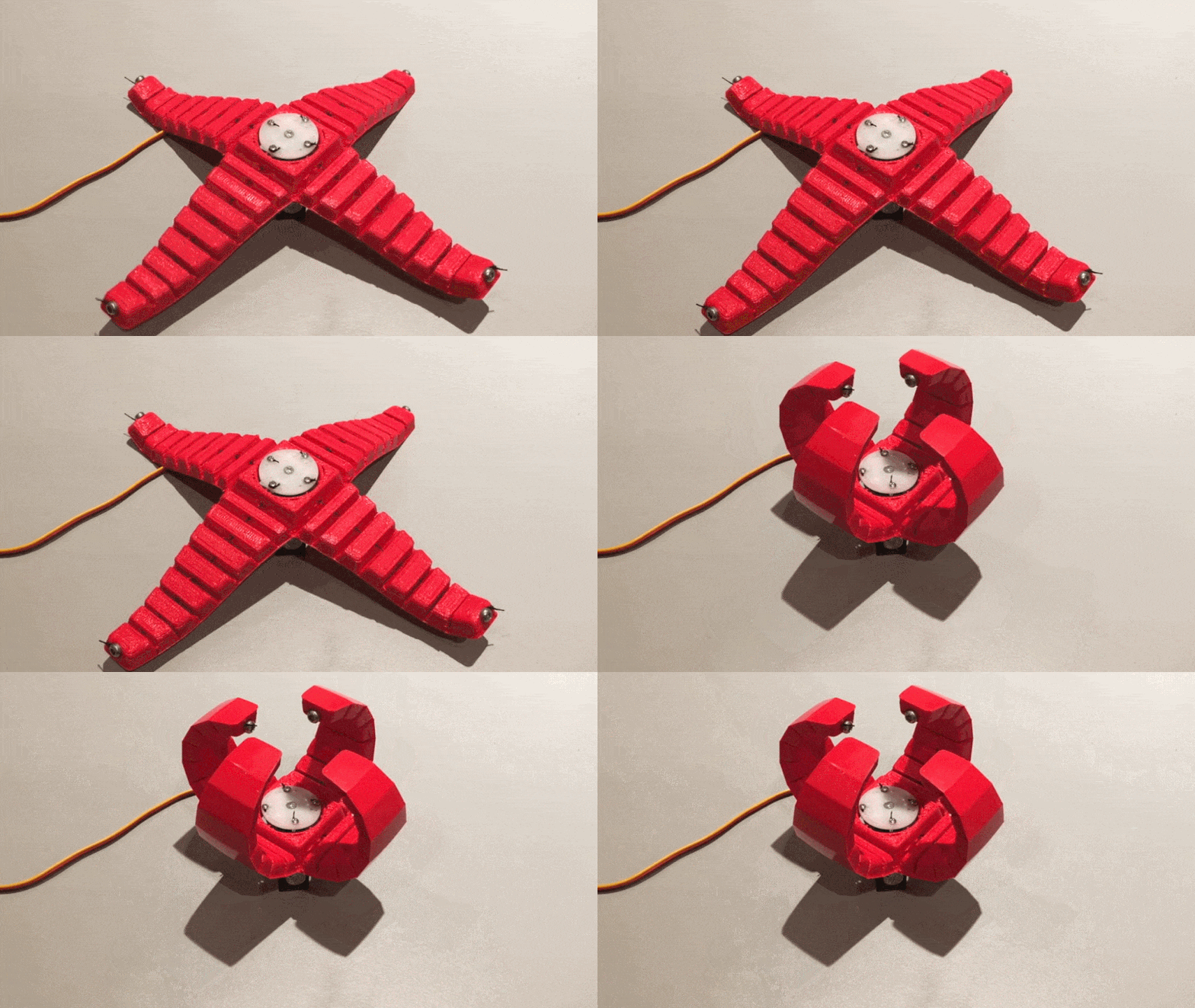
[XYZAiden]’s concept for a flexible robotic gripper might be a few years old, but if anything it’s even more accessible now than when he first prototyped it. It uses only a single motor and requires no complex mechanical assembly, and nowadays 3D printing with flexible filament has only gotten easier and more reliable.

The four-armed gripper you see here prints as a single piece, and is cable-driven with a single metal-geared servo powering the assembly. Each arm has a nylon string threaded through it so when the servo turns, it pulls each string which in turn makes each arm curl inward, closing the grip. Because of the way the gripper is made, releasing only requires relaxing the cables; an arm’s natural state is to fall open.

The main downside is that the servo and cables are working at a mechanical disadvantage, so the grip won’t be particularly strong. But for lightweight, irregular objects, this could be a feature rather than a bug.

The biggest advantage is that it’s extremely low-cost, and simple to both build and use. If one has access to a 3D printer and can make a servo rotate, raiding a junk bin could probably yield everything else.

DIY robotic gripper designs come in all sorts of variations. For example, this “jamming” bean-bag style gripper does an amazing, high-strength job of latching onto irregular objects without squashing them in the process. And here’s one built around grippy measuring tape, capable of surprising dexterity.
KDE Binds Itself Tightly to Systemd, Drops Support for Non-Systemd Systems

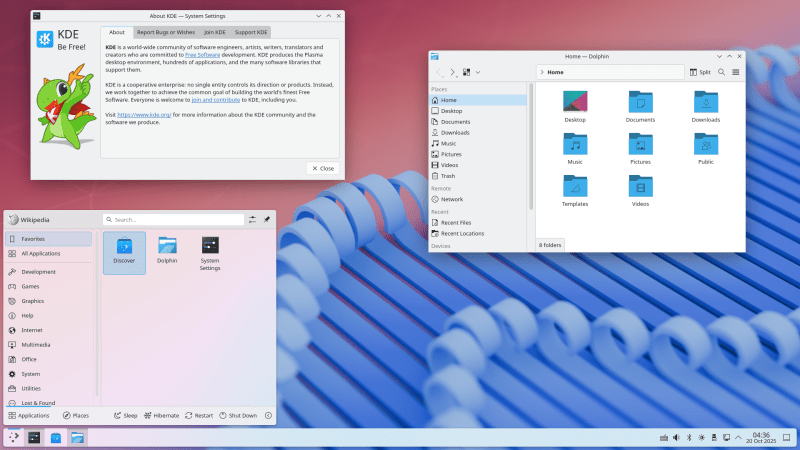
The KDE desktop’s new login manager (PLM) in the upcoming Plasma 6.6 will mark the first time that KDE requires that the underlying OS uses systemd, if one wishes for the full KDE experience. This has especially the FreeBSD community upset, but will also affect Linux distros that do not use systemd. The focus of the KDE team is clear, as stated in the referenced Reddit thread, where a KDE developer replies that the goal is to rely on systemd for more tasks in the future. This means that PLM is just the first step.

In the eyes of KDE it seems that OSes that do not use systemd are ‘niche’ and not worth supporting, with said niche Linux distros that would be cut out including everything from Gentoo to Alpine Linux and Slackware. Regardless of your stance on systemd’s merits or lack thereof, it would seem to be quite drastic for one of the major desktop environments across Linux and BSD to suddenly make this decision.

It also raises the question of in how far this is related to the push towards a distroless and similarly more integrated, singular version of Linux as an operating system. Although there are still many other DEs that will happily run for the foreseeable future on your flavor of GNU/Linux or BSD – regardless of whether you’re more about about a System V or OpenRC init-style environment – this might be one of the most controversial divides since systemd was first introduced.

Top image: KDE Plasma 6.4.5. (Credit: Michio.kawaii, Wikimedia)

[Yang-Hui He] Presents to The Royal Institution About AI and Mathematics

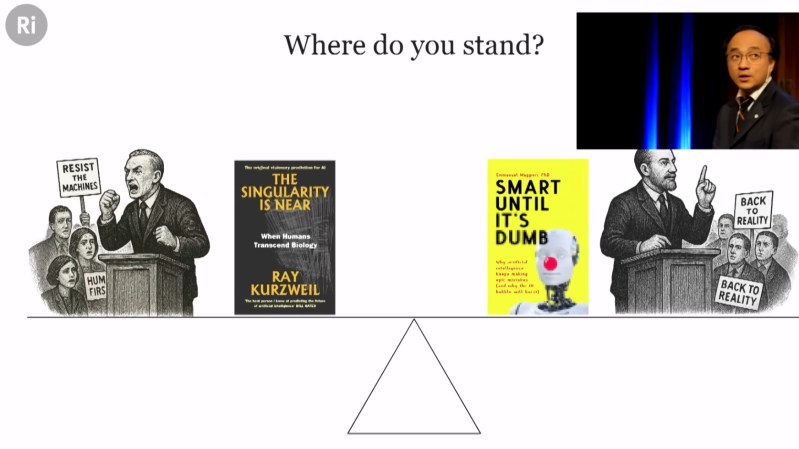
AI. Where do you stand?

Over on YouTube you can see [Yang-Hui He] present to The Royal Institution about Mathematics: The rise of the machines.

In this one hour presentation [Yang-Hui He] explains how AI is driving progress in pure mathematics. He says that right now AI is poised to change the very nature of how mathematics is done. He is part of a community of hundreds of mathematicians pursuing the use of AI for research purposes.

[Yang-Hui He] traces the genesis of the term “artificial intelligence” to a research proposal from J. McCarthy, M.L. Minsky, N. Rochester, and C.E. Shannon dated August 31, 1955. He says that his mantra has become: connectivism leads to emergence, and goes on to explain what he means by that, then follows with universal approximation theorems.

He goes on to enumerate some of the key moments in AI: Descartes’s bête-machine, 1617; Lovelace’s speculation, 1842; Turing test, 1949; Dartmouth conference, 1956; Rosenblatt’s Perceptron, 1957; Hopfield’s network, 1982; Hinton’s Boltzmann machine, 1984; IBM’s Deep Blue, 1997; and DeepMind’s AlphaGo, 2012.

He continues with some navel-gazing about what is mathematics, and what is artificial intelligence. He considers how we do mathematics as bottom-up, top-down, or meta-mathematics. He mentions about one of his earliest papers on the subject Machine-learning the string landscape (PDF) and his books The Calabi–Yau Landscape: From Geometry, to Physics, to Machine Learning and Machine Learning in Pure Mathematics and Theoretical Physics.

He goes on to explain about Mathlib and the Xena Project. He discusses Machine-Assisted Proof by Terence Tao (PDF) and goes on to talk more about the history of mathematics and particularly experimental mathematics. All in all a very interesting talk, if you can find a spare hour!

In conclusion: Has AI solved any major open conjecture? No. Is AI beginning to help to advance mathematical discovery? Yes. Has AI changed the speaker’s day-to-day research routine? Yes and no.

If you’re interested in more fun math articles be sure to check out Digital Paint Mixing Has Been Greatly Improved With 1930s Math and Painted Over But Not Forgotten: Restoring Lost Paintings With Radiation And Mathematics.

❌