Vue lecture

Il y a de nouveaux articles disponibles, cliquez pour rafraîchir la page.

Hackaday Podcast Episode 357: BreezyBox, Antique Tech, and Defusing Killer Robots

In the latest episode of the Hackaday Podcast, editors Elliot Williams and Tom Nardi start things off by discussing the game of lunar hide-and-seek that has researchers searching for the lost Luna 9 probe, and drop a few hints about the upcoming Hackaday Europe conference. From there they’ll marvel over a miniature operating system for the ESP32, examine the re-use of iPad displays, and find out about homebrew software development for an obscure Nintendo handheld. You’ll also hear about a gorgeous RGB 14-segment display, a robot that plays chess, and a custom 3D printed turntable for all your rotational needs. The episode wraps up with a sobering look at the dangers of industrial robotics, and some fascinating experiments to determine if a decade-old roll of PLA filament is worth keeping or not.

Check out the links below if you want to follow along, and as always, tell us what you think about this episode in the comments!

Download this episode in DRM-free MP3 on your ESP32 with BreezyBox for maximum enjoyment.

Where to Follow Hackaday Podcast

Places to follow Hackaday podcasts:

News:

What’s that Sound?

Interesting Hacks of the Week:

Quick Hacks:

Can’t-Miss Articles:

Custom Clamshell Cyberdeck Shows Off Underlighting

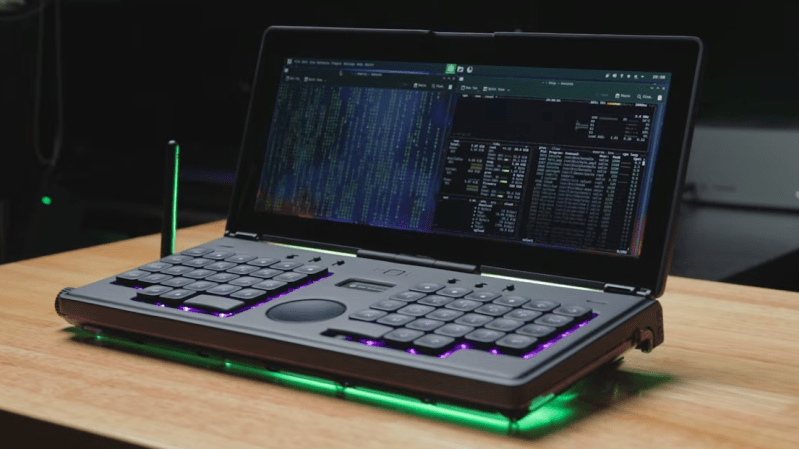
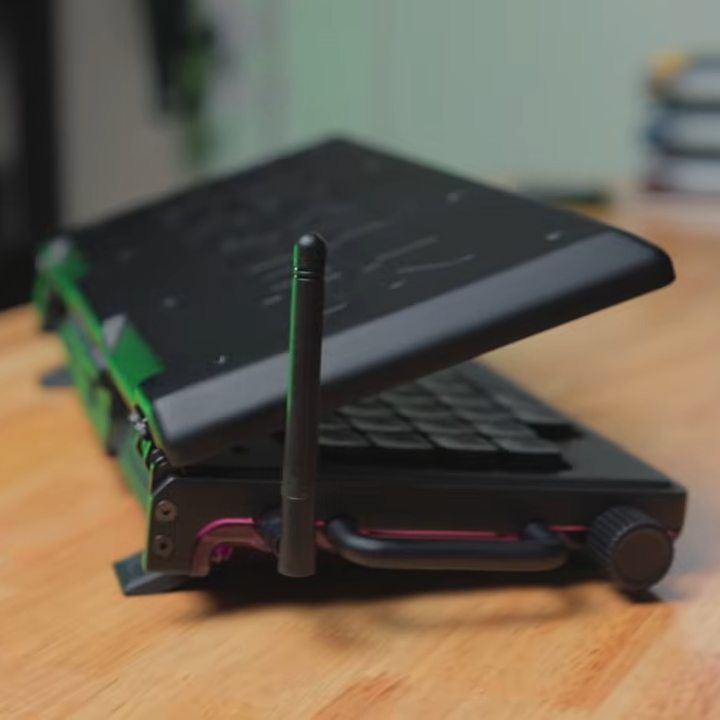
Cyberdecks are great projects, and [Salim Benbouziyane]’s scratch-built CM Deck is a fantastic specimen. It’s a clamshell-style cyberdeck with custom split keyboard, trackpad, optional external WiFi antenna, and some slick underlighting thanks to a translucent bottom shell. There’s even a hidden feature that seems super handy for a cyberdeck: a special USB-C port that, when plugged in to another host (like another computer), lets the cyberdeck act as an external keyboard and trackpad for that downstream machine.

The CM Deck is built around the Raspberry Pi Compute Module 5, which necessitates a custom PCB but offers more design freedom.

Notably, the CM Deck is custom-built around the Raspberry Pi Compute Model 5. When we first peeped the CM5 the small size was striking, but of course that comes at the cost of having no connectors, supporting hardware, or heat management. That’s something [Salim] embraced because it meant being able to put connectors exactly where he wanted them, and not have to work around existing hardware. A custom PCB let him to lay out his cyberdeck with greater freedom, less wasted space, and ultimately integrate a custom-built keyboard (with RP2040 and QMK firmware).

Even the final enclosure is custom-made, with 3D printing being used to validate the design and PCBway providing finished plastic shells in addition to manufacturing the PCBs. [Salim] admits that doing so was an indulgence, but his delight at the quality of the translucent purple undercarriage is palpable.

[Salim]’s video (embedded below) is a deep dive into the whole design and build process, and it’s a great watch for anyone interested in the kind of work and decisions that go into making something like this. Experienced folks can expect to nod in sympathy when [Salim] highlights gotchas like doing CAD work based on the screen’s drawings, only to discover later that the physical unit doesn’t quite match.

The GitHub repository contains the design files for everything, so give it a browse if you’re interested. [Salim] is no stranger to clean builds, so take a moment to admire his CRT-style Raspberry Pi terminal as well.

Thanks [Keith Olson] for sharing the tip!

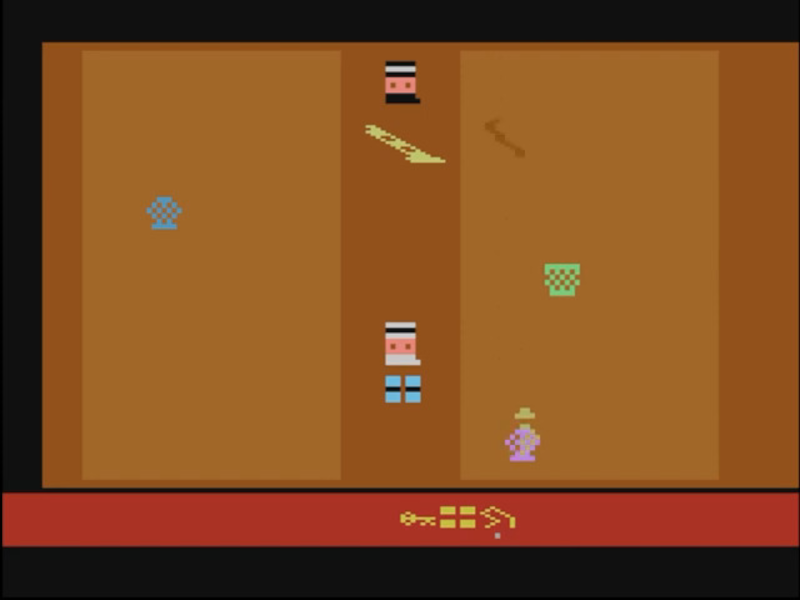
Inside Raiders of the Lost Ark (Atari Style)

It’s a bit ironic that an Atari 2600 game based on Raiders of the Lost Ark — a movie about archaeology — is now the subject of its own archaeological expedition as [Dennis Debro] and [Halkun] spent time reverse-engineering the game. Luckily, they shared their findings, so you can enjoy it the same way you can visit a king’s tomb without having to discover it and dig for it. If you don’t remember the game, you might enjoy the demo from [Speedy Walkthroughs] in the video below.

If you are only used to modern software, you might think this is little more than someone dumping the program code and commenting it. However, on these old, limited systems, you have to really understand the actual architecture because there are so many things you have to manage that are specific to the hardware.

For example, the game has two 4K ROM banks that use a strange switching mechanism. The entire game is built around the NTSC television signal. Everything is oriented toward generating the 60 Hz frame rate. Game logic runs during the vertical blanking and over-scan sections to prevent strange visible artifacts due to software running.

This is a fascinating look inside game coding as it existed around 1982. Of course, you can also run everything using emulation. Usually, our reverse engineering is more hardware-related. But we do love these old games, too.

R2D2 Gets New Brains

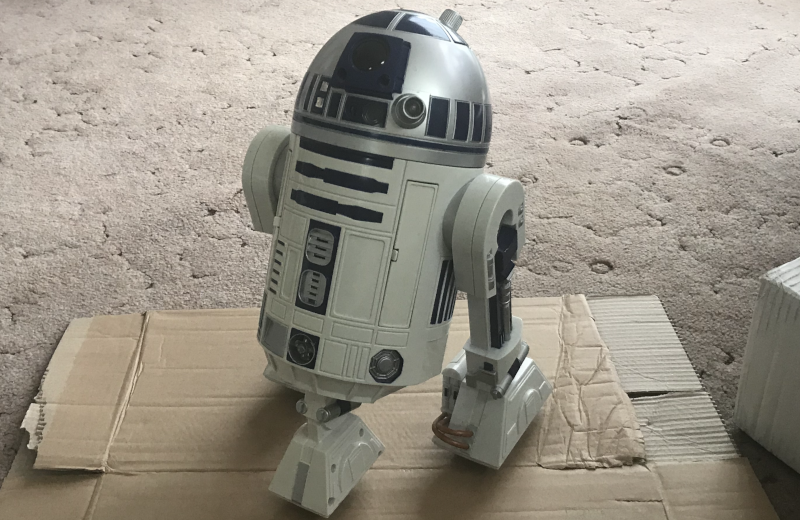
While it is fun to get toys that look like your favorite science fiction props, it is less fun when the electronics in them don’t measure up to the physical design. [Steve Gibbs] took a Hasbro R2D2 toy robot and decided to give it a brain upgrade along with enhanced sensors. You can see a video of the robot doing its thing and some build details below.

In this case, the toy from Hasbro was not working at all, so [Steve] saved it from the dumpster. Instead of a repair, he decided to just gut it and rebuild it with modern electronics. The ultrasonic sensor on the forward toe is a dead giveaway.

The robot responds to voice commands better than the original and can play sound effects and clips from Star Wars. You can also control the robot with a phone app. The new or upgraded sensors include microphones, a PIR sensor, a photoresistor to sense light, a smoke and CO2 sensor, a computer vision camera, and, of course, the ultrasonic range finder.

Some motors and the original speaker are in use, but R2 now sports additional LEDs and servos. All the extras required some surgery on the plastic body. Instead of regular batteries, the ‘bot now uses a LiPo battery, so the old battery compartment was cut out to make more room.

Even if you aren’t a die-hard Star Wars fan, this is a fantastic project, and May the 4th is right around the corner. These toys aren’t cheap, but if you can score one with bad electronics, you might be able to find something cheap or — like Steve — even free.

These toys are popular hacking targets. Now [Steve] needs a pit droid.

❌