 Connexion
Mapping 6,000 Worlds: The New Era of Exoplanetary Data

In the 1990s, astronomers confirmed the first planets orbiting stars beyond our sun. Since then, the tally has risen steadily, and last year it crossed a striking milestone: more than 6,000 known exoplanets. NASA’s Exoplanet Archive has captured not just the growing count but how dramatically the pace has accelerated, as new techniques and space telescopes have come on line. The steepest rises coincide with data releases from NASA’s Kepler space telescope, which discovered thousands of new planets.
With such an extensive catalog of worlds, researchers can look for patterns. They can compare planet sizes, masses, and compositions; track how tightly planets orbit their stars; and measure the prevalence of different kinds of planetary systems. Those statistics allow astronomers to estimate how frequently planets form, and to start making informed guesses about how often conditions arise that could support life. The Drake Equation uses such estimates to tackle one of humanity’s most profound questions: Are we alone in the universe?
The sample is still shaped by the limits of current instruments, which favor large planets in close-in orbits, but that bias may soon ease. NASA’s upcoming Nancy Grace Roman Space Telescope, designed to survey wide swaths of the sky, is expected to find thousands of new planets, especially colder worlds far from their stars. It may reshape the discovery curve once again.
This article appears in the February 2026 print issue as “Six Thousand Alien Worlds and Counting.”
Most Common Methods of Discovery


Types of Planets Found

TERRESTRIAL
These small, dense worlds are made mostly of rock and metal and are comparable in size to Earth or Mars. They can have widely varying temperatures and atmospheres, and some may ultimately prove capable of hosting liquid water.

NEPTUNE-LIKE
These planets are similar in size to Neptune and have thick atmospheres rich in hydrogen and helium surrounding denser, ice-rich interiors. They are larger than super-Earths but far less massive than gas giants.

SUPER-EARTH
These planets are larger than Earth but smaller than Neptune and span a wide range of compositions, from rocky worlds with thick atmospheres to gas-rich planets. They are among the most common exoplanets and have no direct counterparts in our solar system.

GAS GIANT
These massive planets are dominated by hydrogen and helium and lack a solid surface, like Jupiter and Saturn. Some orbit extremely close to their stars as “hot Jupiters,” while others circle at much greater distances.
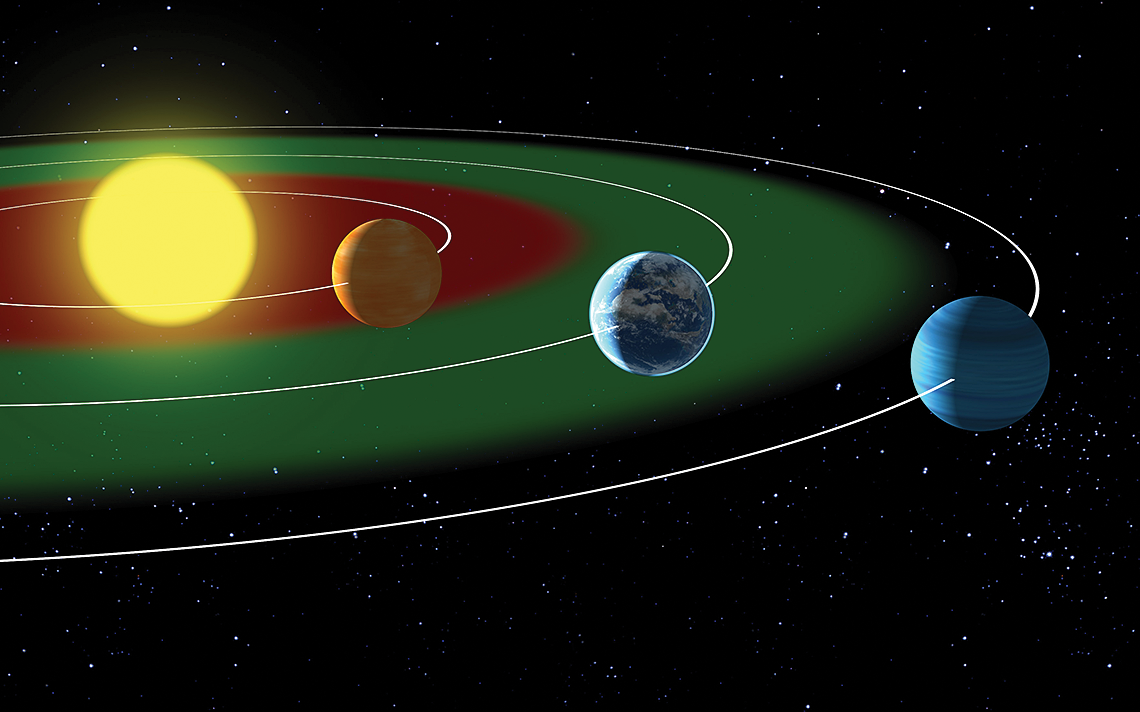
THE “GOLDILOCKS ZONE” [green] is the range of distances from a star where temperatures could allow liquid water to exist on a planet’s surface, depending on the star’s size and brightness. Liquid water is considered essential for life as we know it.